
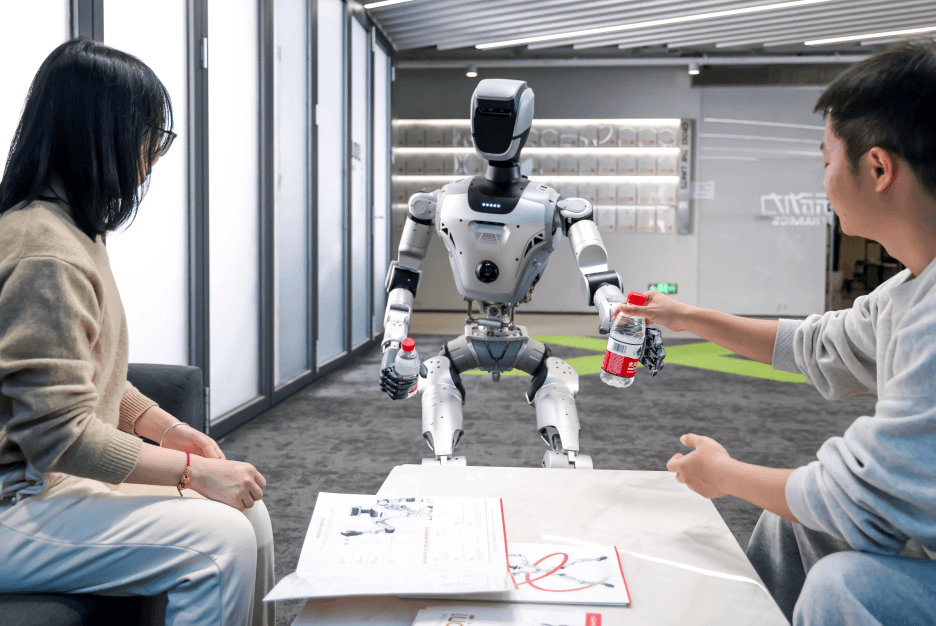
In January 2026, LimX Dynamics showed 18 humanoid robots walking out of shipping crates and moving into formation. They raised $200 million in a pre-IPO round in July 2026.
COSA is LimX's three-layer software architecture for its Oli humanoid: a decision layer, an action layer, and a balance layer, stacked on top of each other. LimX has published genuinely useful technical detail about the bottom two layers. The top layer, the one that's supposed to do the thinking, is a different story. The company describes what it does but not how it works.
This is part of our series on the software behind humanoid robots, alongside our Neuraverse explainer, Figure's Helix and 1X's world model. Our LimX Dynamics manufacturer page covers the company and its robots.
What the name covers
COSA stands for Cognitive OS of Agents. It runs on Oli, LimX Dynamics' full-size humanoid with 43 degrees of freedom. LimX introduced it in January 2026 and published a detailed technical report for version 0.5 in July. The company calls it "the first-of-its-kind agentic OS for humanoid robots".
Three systems, numbered backwards. System 2 handles planning and decisions. System 1 is the vision-language-action layer — it sees the task and generates movements. System 0 keeps the body balanced while carrying them out.
The brain nobody can inspect
System 2 is the cognitive layer. LimX says it can understand natural-language instructions, break tasks into steps, remember things across interactions, and choose which skills to deploy.
LimX’s own example: tell Oli to deliver water to reception, then interrupt it with a request to collect a parcel. According to LimX, the robot reprioritises and replans without freezing.
LimX describes four design ideas: reusable skills the robot can mix and match, multiple AI models coordinating to choose which skills to use, a closed loop that adjusts actions as the task unfolds, and reasoning tied to the robot’s actual body and surroundings rather than running in the abstract.
The company also says COSA maintains semantic memory across encounters, recognising people and recalling previous interactions. Its published material mentions managing “emotion”. It does not explain what that means technically or how it affects the robot’s decisions.
Here’s what LimX hasn’t published: the production language models powering System 2, the memory architecture, the planning algorithm, the skill registry, or any developer-facing API for the cognitive layer. Without those details, the layer making the most ambitious claims is the one the public can least verify. A robot that replays a scripted task sequence and a robot that genuinely replans on the fly are different machines, and the published material doesn’t let us tell which one COSA is.
Where the documentation is strong
System 1 is called V³-0. It’s the best-documented part of COSA, and where the actual engineering lives. V³-0 is a vision-language-action system that separates understanding from execution by running two components at different speeds.
A slow system operates at less than 5 Hz. It takes video from cameras in Oli’s head and wrists, plus a language instruction, and produces a compact internal representation of the scene: what’s there, where it is, what needs to happen next. It doesn’t reconsider the full task at every control step. It refreshes periodically.
A fast system runs at 50 Hz. It takes that representation, combines it with live camera images and the robot’s current joint states, and generates short sequences of whole-body movement targets covering hands, legs, torso and head. While Oli executes one sequence, the system is already generating the next.
Why two speeds? Understanding which mug someone means takes time. Adjusting a reaching arm mid-motion does not. Running both at the same frequency forces a bad trade-off: either the body waits for the brain, or the brain cuts corners to keep up. Separating them avoids both.
LimX names NVIDIA’s GR00T as a reference model for V³-0’s training and inference, though the report doesn’t provide enough detail to call V³-0 a stock GR00T deployment. A technique called Real-Time Chunking smooths the transitions between movement sequences. The setup uses two GPUs; LimX doesn’t say which ones.
The two-speed design is a clear engineering choice, and LimX has published enough about it to actually evaluate.
Keeping the body under control
System 0 is LimX-WBT, the Whole-Body Tracker. It receives a stream of movement targets and works out how to achieve them while keeping Oli balanced.
At its core is a compact Transformer model, running onboard. No offboard computer in the loop. The controller is task-agnostic: trained once, reused across every task without modification. The same controller handles targets from V³-0 and from a human teleoperator. That shared interface is what lets LimX collect human demonstrations and use them to train the layers above.
LimX benchmarked WBT against its own reproduction of SONIC, another whole-body tracker, using identical data and compute. Their reported results (not independently verified):
| Metric (lower is better) | SONIC reproduction | LimX-WBT |
|---|---|---|
| Mean per-joint position error | 13.75 mm | 12.85 mm |
| Mean per-joint angle error | 3.3° | 1.5° |
| Joint-space jerk | 129.2 | 115.2 |
| Base-orientation jerk | 113.0 | 90.3 |
Learning from failure on the real robot
The COSA 0.5 report describes a training loop for situations where imitation learning fails. If the robot attempts a task autonomously and it fails, a human expert takes over whole-body control, corrects the motion, and hands control back. LimX says the handover blends smoothly because both the expert and the policy use the same WBT interface.
The corrections then become training data to create a self-improving loop. Human reviewers label failure clips, which are used to train a reward model estimating task progress over time. The reward signal then drives reinforcement-learning updates on the real interaction data.
LimX’s reported numbers: basket-cleanup success went from 18% to 74% after reinforcement learning. Across three tasks (basket cleanup, placing a plush toy on a chair, stacking boxes), the aggregate failure rate dropped from 39.65% to 11.33%. The company also published a room-tidying demo lasting nearly three minutes in one continuous take: picking up laundry, stacking boxes, clearing toys, adjusting a chair, handing a wallet to a person.
The open-source piece beside the closed one
FluxVLA Engine is LimX’s open-source framework for building, training and deploying embodied-AI models. It is available on GitHub and supports GR00T, Pi0/Pi0.5, Qwen, SmolVLA and others. LimX says V³-0’s training and inference run through FluxVLA. FluxVLA supporting a model doesn’t mean COSA runs that model in production. Access to the training framework doesn’t mean developers get visibility into the cognitive layer.
Two other LimX projects, DreamActor (multi-source training from real robots, simulation and internet video) and VGM (learning manipulation from human videos), are part of the broader ecosystem. Neither is documented as a COSA runtime module.
What’s still behind the curtain
The lower two layers (System 1 and System 0) are well enough documented to explain and evaluate. The cognitive layer, not so much. LimX has not published which language models and world models power System 2, how the memory stores, retrieves and updates information, which algorithm plans tasks and resolves conflicts between skills, or any developer-facing SDK or API for COSA itself.
Also absent is a published safety architecture (emergency stops, collision avoidance, failure recovery), a cybersecurity model, a software-update or fleet-management specification, and the production compute hardware for each layer. LimX’s published results come from its own tests on its own tasks. No cross-environment, cross-user or long-duration reliability data is in the public record from independent evaluations.
TL;DR
- COSA (Cognitive OS of Agents) is a three-layer software architecture running on LimX Dynamics' Oli humanoid.
- System 2 handles planning, memory and skill orchestration. It is also the least documented layer by a wide margin.
- System 1 (V³-0) splits vision-language understanding (< 5 Hz) from action generation (50 Hz). This is the best-documented part of COSA.
- System 0 (LimX-WBT) is a compact onboard Transformer that tracks whole-body motion targets without offboard compute.
- Real-robot RL with expert intervention improved basket-cleanup success from 18% to 74%. Company-reported, not independently verified.
- FluxVLA Engine is open source (Apache-2.0). COSA itself is not.
A well-documented body with an opaque brain
The bottom two layers of COSA are some of the best-documented humanoid software in the public record. The VLA system's two-speed design is a clean engineering choice, and LimX has published enough about it to actually check. WBT runs onboard, handles any task without retraining, and gives LimX a shared interface between autonomous operation and teleoperation. The RL training loop (human corrections turned into reward signals on the real robot) is a practical idea with published numbers behind it.
The cognitive layer is a different conversation. LimX describes an operating system that understands language, plans tasks, maintains memory and orchestrates skills. It has published almost none of the implementation detail that would let anyone assess whether that description is an architecture or an aspiration.
When a company builds the most transparent motion stack in the industry and pairs it with a cognitive layer nobody can inspect, the lower layers aren't the question. The top layer is. And right now, LimX is the only one who can see inside it.