
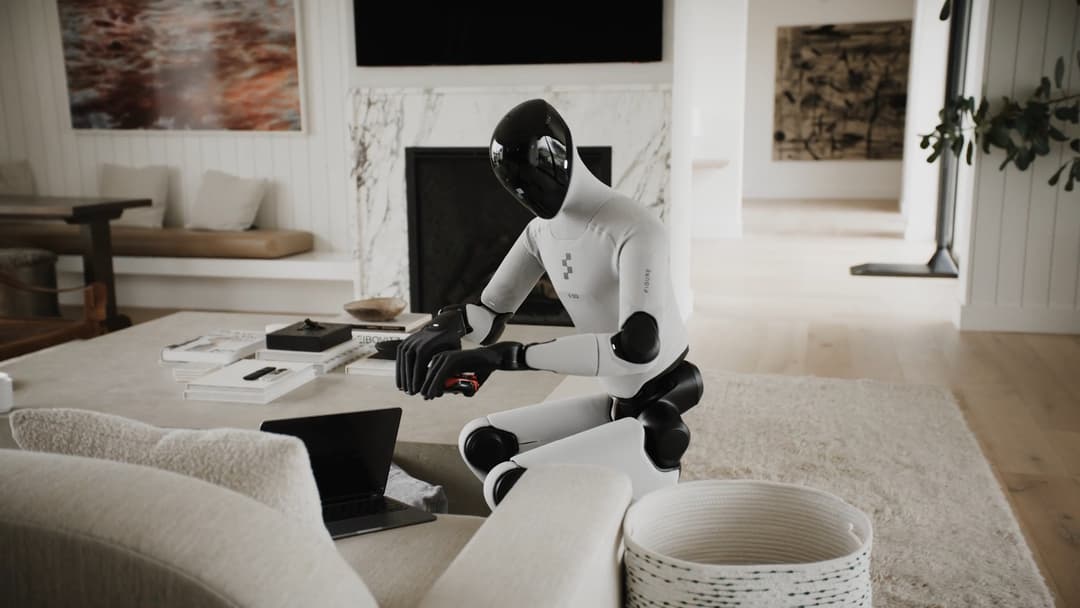
A robot hears "pick up the desert item." It spots a toy cactus, works out how to grab it, and moves its hands into position. It may sound simple, but between the instruction and the movement, a lot has to go right.
Figure AI's Helix splits that job between neural networks that work at different speeds. One interprets the task, another turns that intent into movement and a third keeps the whole body under control. Since February 2025, Helix has evolved through three distinct generations. From an upper-body manipulation system to a whole-body control stack, and most recently to a training approach aimed at unfamiliar homes.
TL;DR
- Helix is Figure AI's AI control system for humanoid robots. It is the software layer that connects what the robot sees and hears, plans its next steps and how it moves.
- Helix, February 2025: A 7-billion-parameter vision-language model works with an 80-million-parameter motor policy. The system controls the upper body at 200 Hz.
- Helix 02, January 2026: Adds a learned whole-body controller running at 1 kHz. The robot can coordinate its legs, balance and manipulation
- Helix 2.5, September 2026: Pretrains on Index, Figure's human-behaviour dataset. Figure reports a 56% task-success rate in 30 previously unseen homes, compared with 9% for a policy trained without Index pretraining.
- The first two generations change what the robot controls. The third changes how it learns.
How the robot brain works
System 2: Understand the instruction
In the original Helix, System 2 is a 7-billion-parameter vision-language model, or VLM. Think of it as the part that connects what the robot sees with what a person asks it to do. It takes camera images, robot-state information and a natural-language instruction and then produces a continuous vector that represents the task intent behind the command. That vector is not a sequence of motor commands. It gives the faster controller information about what the robot is trying to accomplish.
Figure describes the model as open-source and open-weight, pretrained on internet-scale data. It has not named the specific model backbone. Any claim that it uses Qwen, Llama or another named model would go beyond the published evidence.
System 1: Turn intent into movement
System 2 can interpret a request, but it does not directly move the robot. System 1 decides how the body should move given the task and what the cameras currently see. System 1 receives that vector, combines it with visual features and robot-state information, and produces continuous movement targets.
The original version has 80 million parameters and uses a cross-attention encoder-decoder transformer. It runs at 200 Hz, controlling 35 degrees of freedom across the upper body. Its outputs include wrist poses, finger movements, torso orientation and head orientation.
Figure trains the two systems together to learn the relationship between images, language and physical actions. The design also predicts a percentage of task completion, giving the policy a way to estimate when a behaviour has finished and move on to the next one.
The larger model does not have to calculate every small adjustment. System 1 keeps running while System 2 updates its task representation. That's how the robot remains responsive despite having a 7-billion-parameter model in the loop.
In the original Helix deployment, the two systems run on separate embedded GPUs. System 2 updates a shared-memory vector asynchronously, while System 1 uses the latest available version and maintains its control loop. Figure has not published an equivalent hardware diagram for Helix 02 or 2.5, so those original deployment details should not automatically be carried forward.
System 0: Keep the whole body under control
Helix 02 adds System 0, a learned controller for balance, contact and coordinated body movement.
S0 has 10 million parameters. Figure trained it using more than 1,000 hours of retargeted human joint-level motion and reinforcement learning in more than 200,000 parallel simulated environments. It takes body-state information and base motion as inputs, then produces joint-level actuator commands at 1 kHz.
Figure says S0 replaced 109,504 lines of hand-engineered C++ control code. That is a claim about the control code it replaced, not the entire robot software stack.
In April 2026, Figure described an update that gave S0 camera-based terrain perception. A stereo model turns head-camera images into a 3D representation of the surroundings, which S0 uses alongside the robot's own state. Figure reported transferring the resulting controller from simulation to real stair traversal without real-world fine-tuning.
S2 represents the task, S1 converts it into whole-body targets, and S0 handles the faster job of executing those targets while keeping the robot stable.
Three systems, three speeds, three different jobs. The robot does not have one AI brain, it has an AI stack.
Three generations, three different problems
The original Helix focused on upper-body manipulation. Figure reported training it on around 500 hours of teleoperated demonstrations. A vision-language model generated instructions retrospectively by examining the actions in recorded video and asking what instruction would have produced them. Objects seen during training were excluded from evaluation.
By June 2025, Figure had added stereo vision, visual memory, previous robot-state information and force feedback to its logistics policy. These additions helped the robot track objects over time, correct movement and respond to contact. In a specific package-handling evaluation, Figure reported that increasing demonstration data from 10 to 60 hours reduced average handling time from 6.84 to 4.31 seconds per package. Barcode success increased from 88.2% to 94.4%. Those gains came alongside architectural changes, so the results do not isolate the effect of extra training data alone.
Helix 02 expanded the system to the legs and the rest of the body. Figure demonstrated a four-minute dishwasher task involving 61 loco-manipulation actions. It also showed two robots tidying a bedroom. According to Figure, the robots had no shared planner, message passing or central coordinator; each inferred the other's intentions from visual observations.
These are demonstrations, not independent reliability measurements. Looking convincing for four minutes in one kitchen is not the same as working reliably in hundreds of them.
Helix 2.5 takes a different route. Index, Figure's human-behaviour dataset, collects videos of people doing real-world tasks across a range of real-world environments. Figure uses this data to teach its models how people move through and interact with the physical world. Rather than starting with a pretrained vision-language model, Figure says Helix 2.5's foundation model was pretrained from random initialization on Index.
Figure then adapted the model to three tasks: tidying living rooms, folding towels and making beds. In 30 Bay Area homes that had not contributed training data, the Index-pretrained policy achieved a reported 56% task-success rate. A policy trained from scratch on the same downstream task data achieved 9%.
The company says success required completing the whole task, with no partial credit. It also reports matching the success rate of a representative Helix 02 behaviour while using half as much task-specific data. The evaluation homes and objects were unseen during training, but the tasks themselves had been specified through fine-tuning data collected elsewhere. This is evidence of better generalization under defined conditions, not evidence that Helix can perform arbitrary household jobs without task-specific training.
The data behind the models
Figure's training approach draws on three distinct sources.
First, there are teleoperated robot demonstrations, used to teach the original Helix how recorded actions correspond to visual observations and instructions.
Second, Project Go-Big explored learning from human video. In September 2025, Figure reported transferring navigation behaviour from egocentric human video to a robot without robot demonstrations for that navigation result. The company has not disclosed the complete mechanism used to align human video with robot actions.
Third, there is Index. Launched in August 2026, it collects video of people performing real-world tasks. Figure reported more than 16 million uploaded videos, over 44,000 weekly active users and contributions from 108 countries. The scale is notable, but raw video volume is not the same thing as useful training data.

Figure Index App
Index has a data-processing pipeline: filtering, fraud review, deduplication, rebalancing and annotation. Figure uses those stages to screen recordings, remove overly similar clips, balance the dataset and generate text captions. Its September Helix 2.5 results suggest that pretraining on this data helped policies transfer to unfamiliar environments. They do not establish how well the approach works across every possible household task.
What we know, and what we don't
Figure has published substantial detail about Helix's neural-network architecture, selected training methods and several deployment arrangements. It has not published the complete software stack.
The original vision-language model's identity remains undisclosed. So do the parameter counts and complete architectures for later generations, the robotics middleware, the operating system, the model-serving framework and the full low-level safety-control implementation. Knowing how a model maps observations to actions does not tell us everything about how the robot schedules processes, handles hardware or responds to faults.
There is a related effort outside Helix. Figure founder Brett Adcock also founded Hark, a separate AI company building personal AI assistants. TechCrunch reported in March 2026 that Hark's models were already being trained on Figure's robots, though neither company has explained to what end, or whether the work connects to Helix in any way.
Figure has described a credible progression from upper-body manipulation to whole-body control and better generalization to unfamiliar homes. Its performance numbers remain company-reported, and the complete software stack is not public.
Helix is the AI control layer, not a full description of the robot's software. The neural networks are documented in meaningful detail. Everything beneath them — the operating system, the middleware, the safety controls — is a black box.
Sources
Figure's technical publications:
- Original Helix, February 20, 2025: figure.ai/news/helix
- Helix logistics: figure.ai/news/helix-logistics
- Scaling Helix logistics: figure.ai/news/scaling-helix-logistics
- Project Go-Big, September 2025: figure.ai/news/project-go-big
- Figure 03 hardware, October 2025: figure.ai/news/introducing-figure-03
- Helix 02, January 27, 2026: figure.ai/news/helix-02
- Helix 02 bedroom tidy, May 2026: figure.ai/news/helix-02-bedroom-tidy
- Figure 03 production and S0 perception update: figure.ai/news/ramping-figure-03-production
- Index, August 25, 2026: figure.ai/news/introducing-index
- Helix 2.5, September 17, 2026: figure.ai/news/helix-2-5-zero-shot-30-home-generalization
Performance claims in this article come from Figure's own publications and have been attributed accordingly.