
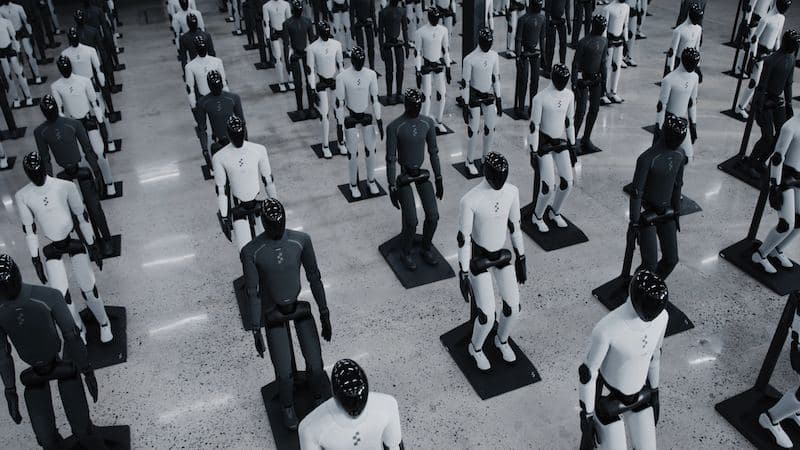
Robotics startup Figure AI has officially transitioned from the prototype phase to large-scale reality, announcing that its BotQ manufacturing facility is now producing its third-generation humanoid, the Figure 03, at a rate of one unit per hour**. This represents a 24x throughput improvement in under 120 days, a milestone the company views as a fundamental shift in its development velocity.
The Engine of Scale: BotQ and Vertical Integration
Located in California, the BotQ facility is engineered to move beyond the expensive, time-consuming nature of traditional engineering prototypes. The factory operates using a custom-built Manufacturing Execution System (MES) that provides full traceability across more than 150 networked workstations.
Figure AI has achieved this scale by vertically integrating the production of its most critical modules, including actuators, batteries, sensors, and electronics, all of which are designed in-house. Key production milestones include:
- Initial annual production capacity at BotQ: 12,000 units
- Total production target over the next four years: 100,000 units
- Already produced across 10 distinct SKUs to support the growing fleet: 9,000+ actuators
- Current first-pass yield for the company’s internal battery line: 99.3% yield
Engineering for Manufacturability
The shift from the Figure 02 to the Figure 03 required a complete hardware redesign focused on manufacturability and cost reduction. While previous generations relied heavily on CNC machining, the Figure 03 utilizes high-volume, tooled processes such as die-casting, injection molding, and stamping.
This transition has enabled Figure AI to target a commercial price point of approximately $20,000, positioning the humanoid to compete directly with human labor on an hourly economic basis. The redesign also resulted in a 9% reduction in overall mass and a significantly lower part count, further streamlining the assembly process.
Data as a Byproduct of Production
For Figure AI, mass production is not just about unit sales; it is a data-collection engine. Every robot that rolls off the line adds to a fleet that generates terabytes of real-world trajectory and telemetry data via 10 Gbps mmWave offloading.
This "flywheel effect" allows the company to harvest edge-case data at scale, feeding it back into the Helix-02 AI system to harden autonomous capabilities. CEO Brett Adcock noted that by running more robots for longer durations—exemplified by a recent 200-hour autonomous livestream—the company has encountered and resolved failures that remained invisible at a smaller scale.
Competitive Landscape
Figure AI's aggressive ramp-up puts it at the forefront of a global race for humanoid dominance. While Tesla is currently retooling its Fremont factory for large-scale Optimus production, and 1X Technologies targets 100,000 units per year by 2027, Figure's current hourly cadence provides a significant "endurance signal" to the market.
As the industry shifts from short demonstration clips to long-duration operational endurance, Figure AI is betting that its ability to master the manufacturing, reliability, and orchestration of these robots will define the next era of physical AI.