
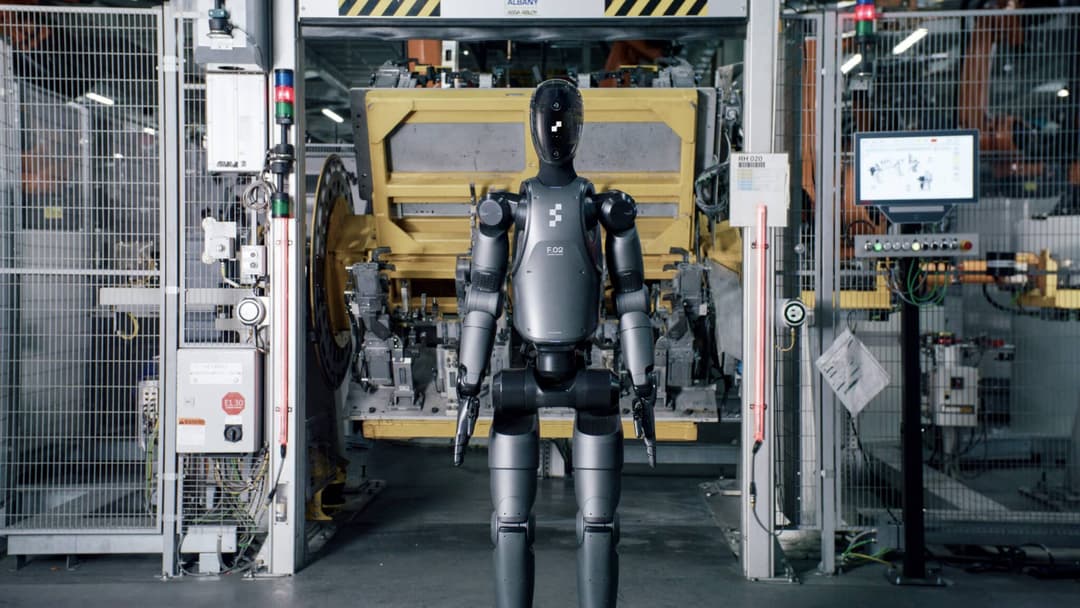
Key facts
- Location: BMW Group Plant Spartanburg
- Duration: 11 months, Monday–Friday, 10‑hour shifts
- Workload: 90,000+ sheet‑metal placements
- Runtime: ~1,250+ hours
- Output contribution: ~30,000 BMW X3 vehicles
- Primary task: pick-and-place sheet‑metal parts into welding fixtures
- Industrial KPIs used: target cycle time (84 s full cycle; 37 s load), placement accuracy (>99%), near‑zero human resets
What happened
Figure’s F.02 was integrated into an active BMW line to perform a constrained but production‑critical task: pick sheet‑metal parts from racks and place them into a welding fixture. Conventional six‑axis robots then performed welding and continued the process. Over sustained operation the humanoid executed tens of thousands of placements under real factory cadence and constraints.
Engineering lessons & failure modes
- Reliability data matters: Continuous runtime exposed wear, thermal stress, and packaging limits that short demonstrations don’t reveal.
- Forearm electronics weakness: The forearm subsystem experienced overheating and reliability issues under sustained load. Tight packaging and a microcontroller‑based distribution board were identified as root factors.
- Design response: F.03 redesign removes the distribution board, simplifies wiring, and routes motor‑controller communication directly to the main computer to reduce thermal and reliability risk.
Why this matters for physical AI
Short demos demonstrate capability; long deployments validate engineering. Large, repeated runs generate actionable data on throughput, failure modes, and maintainability — all prerequisites for moving humanoid systems from PR demos to dependable production tools. This pilot produced measurable metrics that informed real design changes rather than theoretical improvements.
What remains unknown
- Exact intervention/reset rates per shift.
- Comparative throughput vs. human operators or fixed automation for the same task.
- Total cost of ownership over multi‑year operation.
Source notes
This article is a concise recap of the reported Figure‑BMW deployment metrics and engineering outcomes. For the original Figure report and deployment details, consult Figure.ai’s public release and contemporaneous press coverage.