
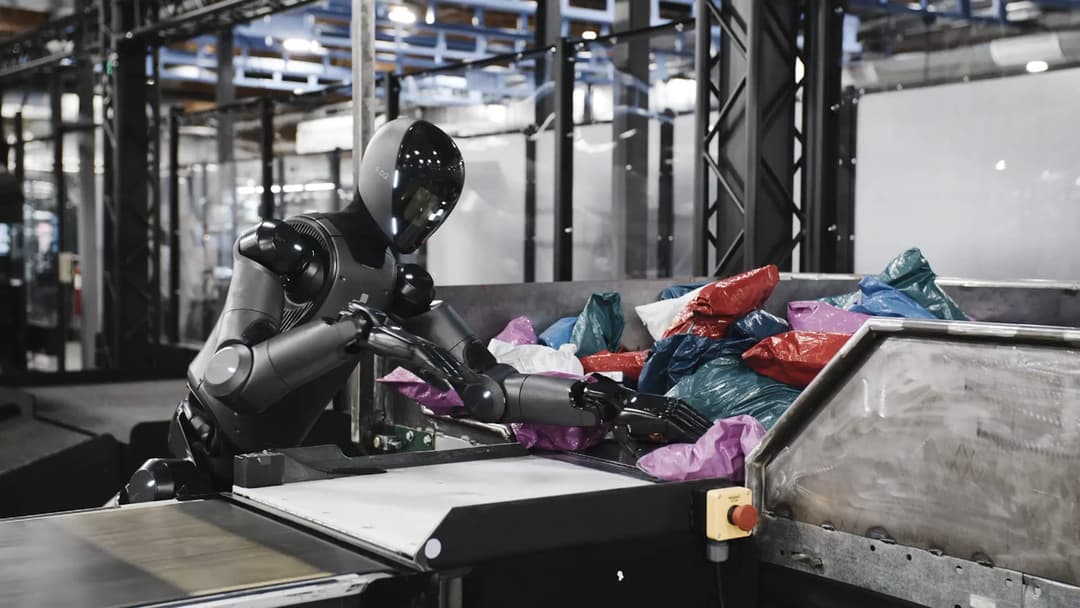
In a landmark series of demonstrations at its San Jose headquarters, robotics startup Figure AI has pitted its third-generation humanoid, the Figure 03, against human performance in a grueling logistics marathon. The events, which included a 10-hour "Man vs. Machine" head-to-head contest and an unprecedented 200-hour autonomous livestream, have shifted the industry benchmark from short demonstration clips to long-duration operational endurance.
The "Man vs. Machine" Challenge: Human Victory at High Physical Cost
On May 18, 2026, Figure AI concluded a structured 10-hour competition between a college intern named Aime and the Figure 03 robot. The task mirrored standard warehouse labor: detecting barcodes, picking up small packages, and reorienting them face-down on a conveyor belt. The results were remarkably close:
- Aime (Human): Sorted 12,924 packages at an average speed of 2.79 seconds per package.
- Figure 03 (Robot): Sorted 12,732 packages at an average speed of 2.83 seconds per package. While Aime secured a narrow victory by approximately 192 packages, the human performance required extreme physical exertion. By the end of the shift, Aime reported severe fatigue, blisters, and noted that his left forearm was "basically broken," suggesting he could not have sustained the pace much longer. Figure AI CEO Brett Adcock reacted by predicting that this would be "the last time a human will ever win," highlighting the minimal 0.04-second speed difference and the robot’s immunity to physical exhaustion.
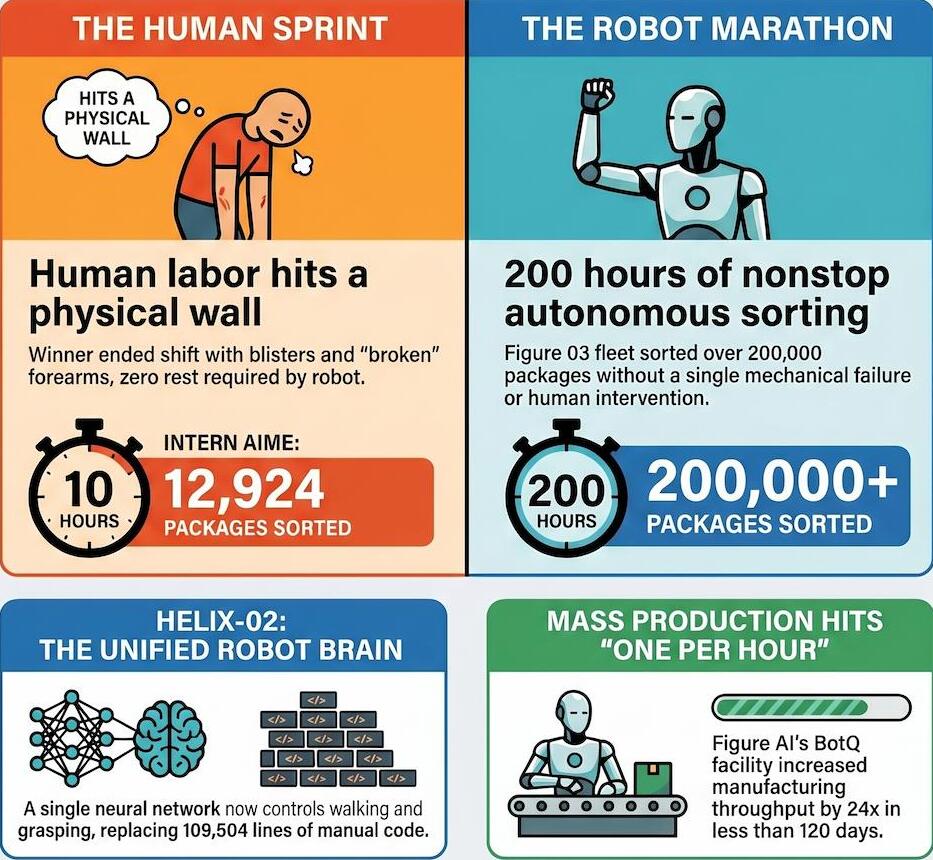
Man Versus Machine Labor Comparison
The 200-Hour Autonomous Livestream
Following a public challenge from robotics expert Dr. Scott Walter regarding the commercial viability of humanoid shifts, Figure AI launched a nonstop YouTube livestream on May 13, 2026. Although initially planned as an 8-hour demonstration, the run was dynamically extended after the robots exhibited zero systemic failures. The livestream ultimately concluded on May 22 after 200 continuous hours—roughly nine calendar days—of autonomous operation. Key milestones from the livestream included:
- 24 Hours: Over 28,000 packages processed with zero reported failures.
- 72 Hours: Total reached 88,000 packages sorted at a sustained pace of 2.9 seconds per item.
- 81 Hours: The robot "Jim" surpassed 101,391 parcels while maintaining "dark factory" potential.
- 200 Hours: The test concluded with an approximate 250,000 packages sorted without mechanical breakdown. The demonstration utilized a relay of robots (nicknamed Gary, Bob, Frank, and Rose) that rotated in and out of the work cell. When a unit's battery neared its five-hour limit, it would autonomously walk to a 2 kW wireless inductive charging dock, allowing a fresh robot to take over the workstation seamlessly.
Technical Breakthroughs and Expert Critique
The performance was powered by Helix-02, a unified vision-language-action (VLA) AI system that handles all reasoning and control entirely onboard via dual GPUs. A critical component, System 0, replaced over 109,000 lines of hand-engineered C++ code with a neural motion prior trained on 1,000+ hours of human kinematics, enabling more natural and stable full-body movement. Despite the technical success, some experts remain cautious. Ayanna Howard, Dean of Engineering at The Ohio State University, characterized the livestream as more of a "science project" than a mature commercial service. She pointed out that while the speed was impressive, the robot occasionally made mistakes, such as dropping packages or misaligning labels, noting that in real-world logistics, absolute accuracy often outweighs raw speed.
Market and Industrial Implications
The demonstrations coincide with Figure AI’s aggressive scaling at its BotQ facility, which is now reportedly producing one Figure 03 unit per hour. With a private valuation reaching nearly $40 billion, Figure AI is positioning the $20,000 Figure 03 as a general-purpose labor tool capable of transitioning between warehouse sorting and home tasks, such as kitchen cleanup or laundry. While the livestream provided a significant "endurance signal" for investors, industry analysts emphasize that the next phase will require independent proof of predictable maintenance costs and error recovery in less controlled, non-laboratory environments.