
GR-2
Full-size research humanoid with 53 degrees of freedom and hot-swappable battery, built on Fourier's FSA 2.0 actuator platform
Contact for Pricing
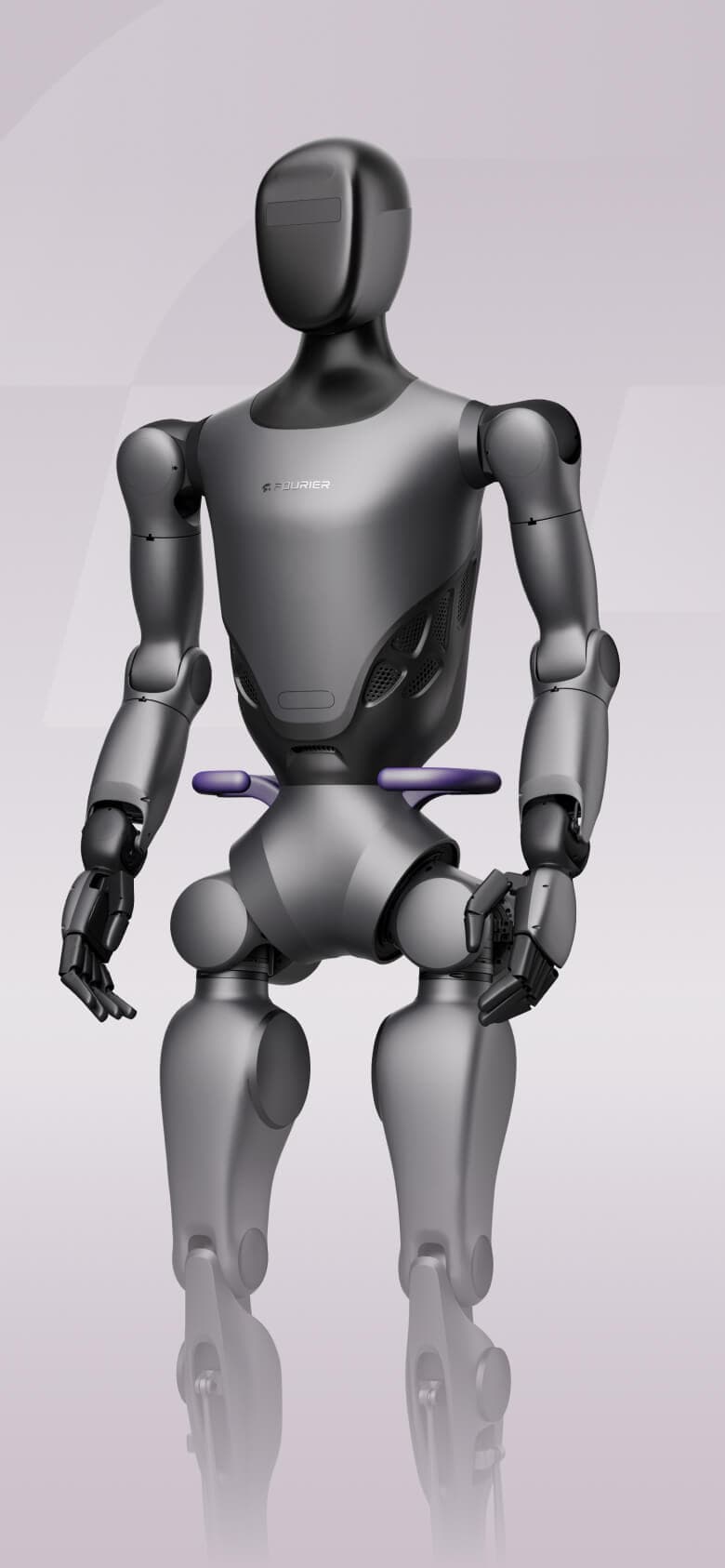
Technical Details
Specifications
| Height | 1.75 m / 5' 9'' |
|---|---|
| Weight | 63 kg / 138.9 lb |
| Degrees of Freedom | 53 |
| Locomotion | biped |
| Payload | 3 kg |
| Battery Type | — |
| Speed | 1.39 m/s |
| Rated Runtime | 2 h |
Sensors
| Cameras | — |
|---|---|
| Depth Sensing | Not disclosed |
| Lidar | Not disclosed |
| IMU | Not disclosed |
| Microphones | Not disclosed |
| Tactile Sensing | 6 array-type tactile sensors enabling force detection, material identification, and grip adjustment |
Software
| Control Mode | autonomous, teleoperation |
|---|---|
| Middleware | — |
| SDK | Open |
| SDK Details | Public SDK on GitHub (FFTAI org); supports NVIDIA Isaac Lab, ROS, MuJoCo |
| Connectivity | — |
Deployment
Units Shipped: Not publicly disclosed
As of Aug 2026
Company Claim
Fourier's own GR-2 product page names ETH Zurich, Carnegie Mellon University, Simon Fraser University, and Tsinghua University as research partners, and Fourier separately published a demonstration video of GR-2 performing tasks at an SAIC-GM automotive facility
What's Actually Confirmed
The four research partners are confirmed directly on Fourier's own page. The SAIC-GM appearance is a company-published demo video, not an independently confirmed production deployment — CnEVPost's March 2026 reporting on SAIC-GM's actual production-line humanoid identifies it as a wheeled robot built by AGIBOT, a different manufacturer, not Fourier's GR-2
ETH Zurich, Carnegie Mellon University, Tsinghua University
Multiple, per institution
| Task | Locomotion, manipulation, human-robot interaction, and embodied AI research |
|---|---|
| Stage | Production |
| Start Date | Sept 2024 |
| End Date | — |
Frequently Asked Questions
What is the GR-2 and who makes it?
GR-2 is a full-size research humanoid with 53 degrees of freedom and hot-swappable battery, built on Fourier's FSA 2.0 actuator platform. It is manufactured by Fourier Robots and was announced in 2024.
How tall is the GR-2?
GR-2 is 1.75 m / 5' 9'' tall.
How much does the GR-2 weigh?
GR-2 weighs 63 kg / 138.9 lb.
How much can the GR-2 carry?
GR-2 can carry a payload of 3 kg.
How much does the GR-2 cost? Is the GR-2 available to buy?
Fourier Robots has not published a price for the GR-2 — it is quoted on enquiry. No public pricing. Contact Fourier Robotics directly.
What are the main strengths of the GR-2?
- 53 DoF with 12 DoF per hand — high dexterity for a research platform
- FSA 2.0 actuators with 380 N·m peak torque and dual-encoder precision
- Hot-swappable battery for reduced downtime
- Broad simulation compatibility — Isaac Lab, ROS, MuJoCo
- Established research deployments at top-tier institutions
What are the limitations of the GR-2?
- 3 kg single-arm payload limits industrial task applicability
- No public pricing — purchase process opaque
- 2-hour battery runtime is short for extended experiments
- No independently verified autonomous task benchmarks published
- No confirmed industrial/production deployment — the widely-circulated 'SAIC-GM deployment' claim is a demo video, not a production relationship
Related Humanoids


Last updated: Aug 2026