
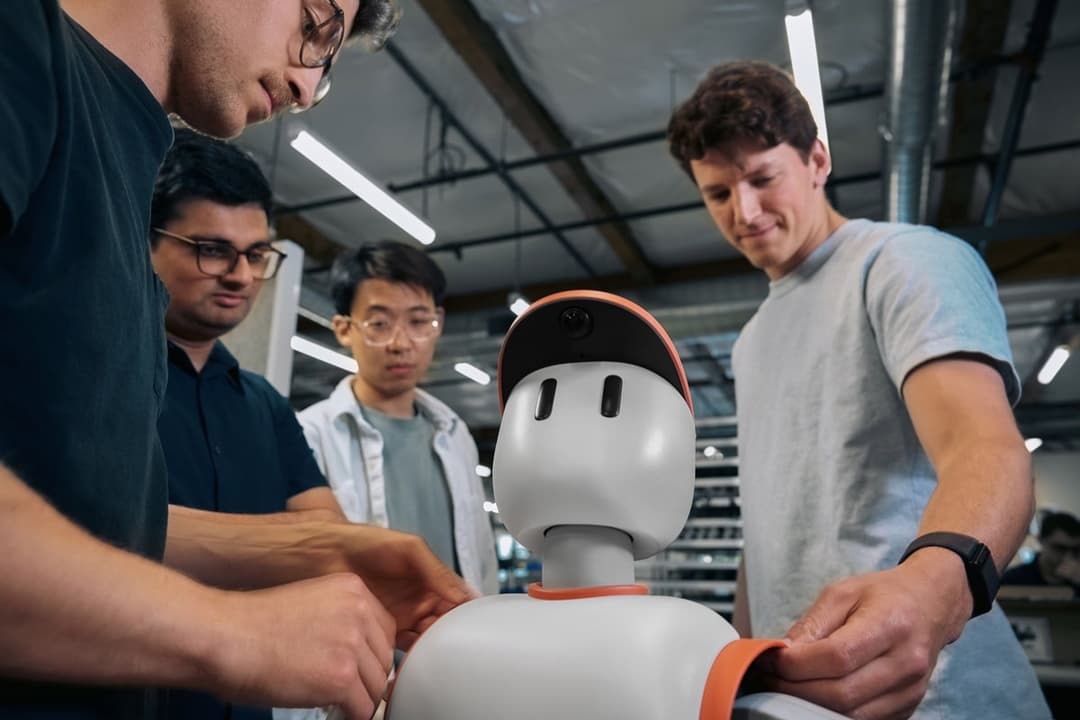
The robotics sector is undergoing a fundamental shift from laboratory curiosity to commercial execution, fueled by Series B tailwinds that prioritize vertical integration over academic optics. Sunday Robotics’ recent funding represents a high-conviction signal that the industry is ready to transition from "viral" video demonstrations toward the messy, unstructured environments of general-purpose autonomy. By securing unicorn status, Sunday has positioned itself to bridge the gap between "embodied AI" research and the mass-market deployment of functional domestic hardware.
Fast Facts: The Series B Milestone
- Round Size: $165 Million
- Current Valuation: $1.15 Billion
- Lead Investor: Coatue Management (Thomas Laffont)
- Founders: Tony Zhao (CEO) and Cheng Chi (CTO)
- Total Funding to Date: $200 Million
The primary directive for this capital is a decisive pivot away from research-oriented showcases. As CEO Tony Zhao stated, the round serves a singular mission: to "stop giving demos" and focus entirely on the logistical and technical hurdles of real-world deployment. This strategy is underpinned by a cap table featuring the power players of the "Tiger Cub" and Tier-1 venture landscape.
The Cap Table: Strategic Backing and Board Evolution
The pedigree of Sunday’s investors validates the company's "full-stack" approach, a necessity in an industry where software-only solutions often fail against hardware realities. Coatue Management’s lead position is particularly telling; the firm was a 2021 seed investor in Sunday, signaling long-term conviction in the founders’ roadmap. By doubling down at a $1.15 billion valuation, these investors are betting that Sunday's vertical integration is the only viable path to domestic robotics at scale.
The funding consortium represents a blend of venture expertise and institutional scale:
- Lead Investor: Coatue Management
- Venture Capital Giants: Bain Capital Ventures, Benchmark, Conviction, and Xtal Ventures.
- Institutional/Management Firms: Fidelity Management & Research Company and Tiger Global Management.
As part of this round, Coatue co-founder Thomas Laffont has joined the Sunday board. Laffont, who has tracked the founders since their days at Stanford and Columbia, cited Tony Zhao’s "velocity of excellence" as the round’s primary motivator. This board evolution marks Sunday’s transition from a promising lab spin-out into a mature corporate entity with the governance required to dominate the domestic market.
The Sunday Flywheel: Solving the Data Bottleneck
A persistent "Data Deadlock" has long hampered robotics: models need high-quality data to learn, but collecting that data typically requires slow, lab-bound processes. Sunday has bypassed this via a proprietary flywheel utilizing the Skill Capture Glove™, a $200 wearable that enables crowdsourced data collection. Unlike Tesla’s expensive teleoperation labs, Sunday’s data is gathered "in the wild" by over 500 "Memory Developers" recording chores in their own messy homes.
This infrastructure leverages foundational research breakthroughs from the founders, who famously met on Twitter/X after publishing landmark papers—Zhao’s ALOHA and ACT-1 (Action Chunking with Transformers) and Chi’s Diffusion Policy and UMI (Universal Manipulation Interface)—within a month of each other.
- Cost Efficiency: Sunday uses a 3D-printed UMI gripper and a $200 wearable glove, contrasting with academic rigs costing several hundred thousand dollars.
- Scale of Data: Sunday has amassed 10 million movement episodes, utilizing ACT-1 to predict trajectories rather than single-step actions, resulting in more consistent motion.
- Environmental Realism: Data is collected in real kitchens with unpredictable lighting and obstacles, providing the "distribution matching" necessary for domestic reliability.
By owning the hardware, the data capture tools, and the models, Sunday can iterate at record speeds. This was demonstrated by a complex "table-to-dishwasher" cycle developed in just three months—a feat that established the technical moat justifying their valuation.
Product Spotlight: "Memo" and the Functionalist Design Philosophy
Sunday’s flagship robot, Memo, eschews the bipedal humanoid form factor for a utility-first design. Clad in a soft, silicone-like shell for home safety, Memo is optimized for the specific constraints of domestic architecture rather than human mimicry.
Key technical features of the Memo platform include:
- Passive Stability: A wheeled base ensures power efficiency and avoids the "balancing act" hurdles of bipedal designs.
- Telescoping "Z-axis" Spine: An adjustable spine allows the robot to reach from floor level to 2.1-meter-high shelves.
- Three-Fingered Dual-Grippers: Designed for "force closure," these grippers allow Memo to handle fragile wine glasses or fold socks with fine-grained dexterity.
Despite this functionalism, Memo features a "cartoon-like," friendly face to avoid the "Terminator" aesthetic of industrial machines. Tony Zhao’s goal remains a robot that is "cheap, safe, and capable" for the billion-home market—a vision that has ignited a high-stakes talent war.
The Talent War: Poaching the "Tesla Full Stack"
Sunday Robotics is currently the primary beneficiary of a "brain drain" from Tesla’s Optimus and Autopilot programs. The migration of senior leadership to a 70-person startup reveals a profound shift in engineering sentiment toward Sunday’s data-first mission.
Key hires from the Tesla ecosystem include:
- Nishant Desai: A five-year veteran of Tesla’s ML team (Autopilot/FSD).
- Nadeesha Amarasinghe: Former Engineering Lead for AI Infrastructure at Tesla with a 7-year tenure, responsible for the backend systems training Optimus.
- Perry Jia: A key engineer on the Optimus and Autopilot programs who now leads Data Operations at Sunday.
- Jason Peterson: A former recruiter for Tesla’s Optimus and Robotaxi programs.
While giants like Tesla rely on massive capital, Sunday’s recruitment surge—10,000+ applications in three months—highlights the draw of "in-the-wild" robotics. This team is now tasked with executing an aggressive roadmap toward mass adoption.
Roadmap to Thanksgiving 2026: From Beta to Mass Adoption
The upcoming 2026 Beta program will serve as a "learning lab" for consumer behavior in unstructured environments. Sunday will deploy 50 uniquely numbered units to "Founding Families" to iterate on real-world reliability and safety.
The roadmap for scaling domestic labor includes:
- Founding Family Beta (Late 2026): Initial deployment to 50 households for real-world stress testing.
- Beta Shipping Window: Targeted deliveries centered around Thanksgiving 2026.
- Mass Adoption Transition (2027+): Transitioning from $20,000 CNC-machined prototypes to injection-molded units, targeting a consumer price point under $10,000.
CTO Cheng Chi views this trajectory as the "ChatGPT moment" for robotics—a phase where scaling training recipes transforms promising research into autonomous reality. If Sunday can successfully drop the marginal cost of household labor to zero, Memo will become the most significant domestic appliance since the washing machine.