
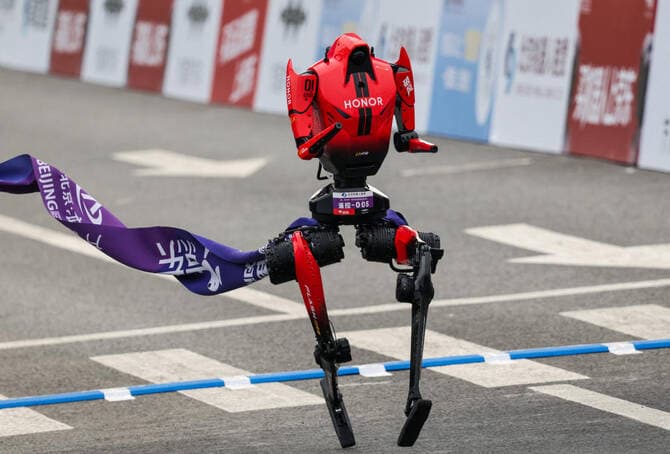
Human champion Zhao Haijie achieved an elite time of 1:07:47, he finished nearly 17 minutes behind the mechanical winner. For the first time in modern athletic history, the podium belonged not to biology, but to engineering.
The 50-Minute Barrier: How Honor's Robot Rewrote the Record Books
Honor, the Chinese consumer electronics giant that entered the robotics sector less than a year ago, unleashed "Lightning" (also referred to as "Flash" in technical reports)— a humanoid robot that obliterated the previous half marathon record for autonomous robots.
Key Performance Metrics:
- Humanoid Lightning's time: 50:26
- Human world record (Jacob Kiplimo): 57:20
- Improvement: 7 minutes faster
- Height: 169 cm
- Leg length: 95 cm
- Cooling technology: Liquid cooling system adapted from smartphone engineering
In distance running, a seven-minute gap represents not a marginal achievement but a complete generational leap. Jacob Kiplimo's current human world record of 57:20 would take years of biological training and genetic optimization to approach. Lightning achieved it in a single year of iterative engineering.
"To see a machine navigate a 21-kilometer course entirely on its own while maintaining that kind of burst power is a staggering achievement in robotics," engineering analysts noted. "It validates that we can now sustain athletic output that exceeds biological limits for the duration of an entire race."
A 300% Jump in One Year
The most striking comparison isn't between humans and robots—it's between last year's Beijing marathon and this year's event. The progress is staggering and reveals how rapidly the robotics industry is scaling.
| Metric | 2025 Beijing Half Marathon | 2026 Beijing Half Marathon |
|---|---|---|
| Robots completed | 1 out of 20 teams (6 total) | 47 robots completed |
| Teams competing | 20 teams | 102 teams |
| Winning time improvement | N/A | 110 minutes faster |
| Overall progress | Barely functional prototypes | Industrial-scale deployment |
This dramatic acceleration isn't the result of breakthrough physics—it's industrial manufacturing at scale. Hundreds of suppliers across Beijing's robotics cluster are driving down the cost and weight of joint modules, servo motors, and structural components. In just 12 months, the industry pivoted from "barely functional prototypes" to "practical, deployable systems."
"The aim is to cultivate task-capable humanoid 'workers'—workshop operators, household assistants, and firefighters—and to explore a new model that links competition with industry by 'winning medals first, and securing orders.'"
The $100 Billion Question: How Beijing Is Engineering the Future
This isn't organic market development. The records shattered in Beijing are the direct result of a 100-billion-yuan ($14 billion USD) government investment fund specifically designed to accelerate humanoid robot development. Beijing's industrial policy is treating robotics like a strategic national priority—comparable to semiconductor manufacturing or electric vehicles.
This capital is lubricating a machine that's rapidly moving from demonstration events to actual deployment. Every month that passes sees faster iteration, cheaper components, and more robust autonomous systems.
What This Means for Workers, Athletes, and Society
The humanoid marathon record represents a psychological and technical inflection point. For the first time, we're not discussing hypothetical robotics capabilities—we're analyzing actual performance metrics that exceed human biology.
The questions shifting on the horizon:
- Labor markets: If humanoid robots can outperform humans in endurance tasks, what sectors of the economy are vulnerable to automation in the next 5–10 years?
- Athletic entertainment: Do we create separate robot sports leagues? Or do we accept that the "world record" is now a machine category?
- Governance: How do nations regulate the deployment of humanoid robots in workplaces, healthcare, and public spaces?
The "Human Era" of physical records is effectively closed. We have entered a period where the benchmark for speed, precision, and strength is no longer biological. The question for society is no longer if humanoid robots can match and exceed human capability—they've already done it.