

Most humanoid robots give themselves away the moment they move. The proportions might be right, but something in the gait, the torso rotation, the way the arm swings, reads as mechanical.
For XPENG's engineers building their humanoid robot, IRON, that meant rethinking almost every layer of the machine — from its skeleton and muscles, to its skin, and right up to control software. Rather than treating appearance as a cosmetic problem, the engineering team approached it as a mechanical one. One of the ideas that pushed the project forward didn't come from a biomechanics paper or a research lab. It came from a hollow lattice "lettuce toy" sitting on a teammate's desk.
A General-Purpose Humanoid Framework
Most industrial robots are designed around actuators, structural strength, and packaging constraints. Their appearance is largely a consequence of those engineering decisions. XPENG says it started from a different premise: build a general-purpose humanoid framework whose proportions and joint layout follow the mechanics of the human body as closely as practical. That framework defines where major joints sit relative to one another, how body segments connect, and how motion flows through the robot.
"Engineering and design don't naturally align; they each have their own rules, their own logic, and they often pull in different directions," said XPENG's product design expert. That created a constant tension between engineering and industrial design. Rather than treating the exterior as something added after the hardware was finished, XPENG developed both together. Decisions about proportions, joint placement, and mechanical packaging were made simultaneously because each affected how the finished robot would move.
The "Lettuce Toy" Breakthrough
Replicating the behavior of human muscles is one of the hardest problems in humanoid robotics. Solid foams lack elasticity. Silicone can deform, but doesn't reproduce the complex combination of compression, expansion, energy dissipation, and recovery found in biological tissue. According to XPENG's engineers, the breakthrough came unexpectedly from a small hollow lattice "lettuce toy" sitting on a teammate's desk. Its repeating internal structure suggested a different way to build artificial muscles. "The flexible, hollow structure had just the right properties for muscle behavior... it immediately gave us an idea."
Instead of relying on solid materials, XPENG developed muscle-like components built from lattice geometries. Different lattice patterns serve different purposes. Softer regions compress more easily, while more elastic structures provide strength and resilience where higher loads are expected.
Besides reducing weight, the lattice architecture lowers internal resistance during movement and helps dissipate heat. The result is a structure that stretches and compresses more like soft tissue than solid materials.
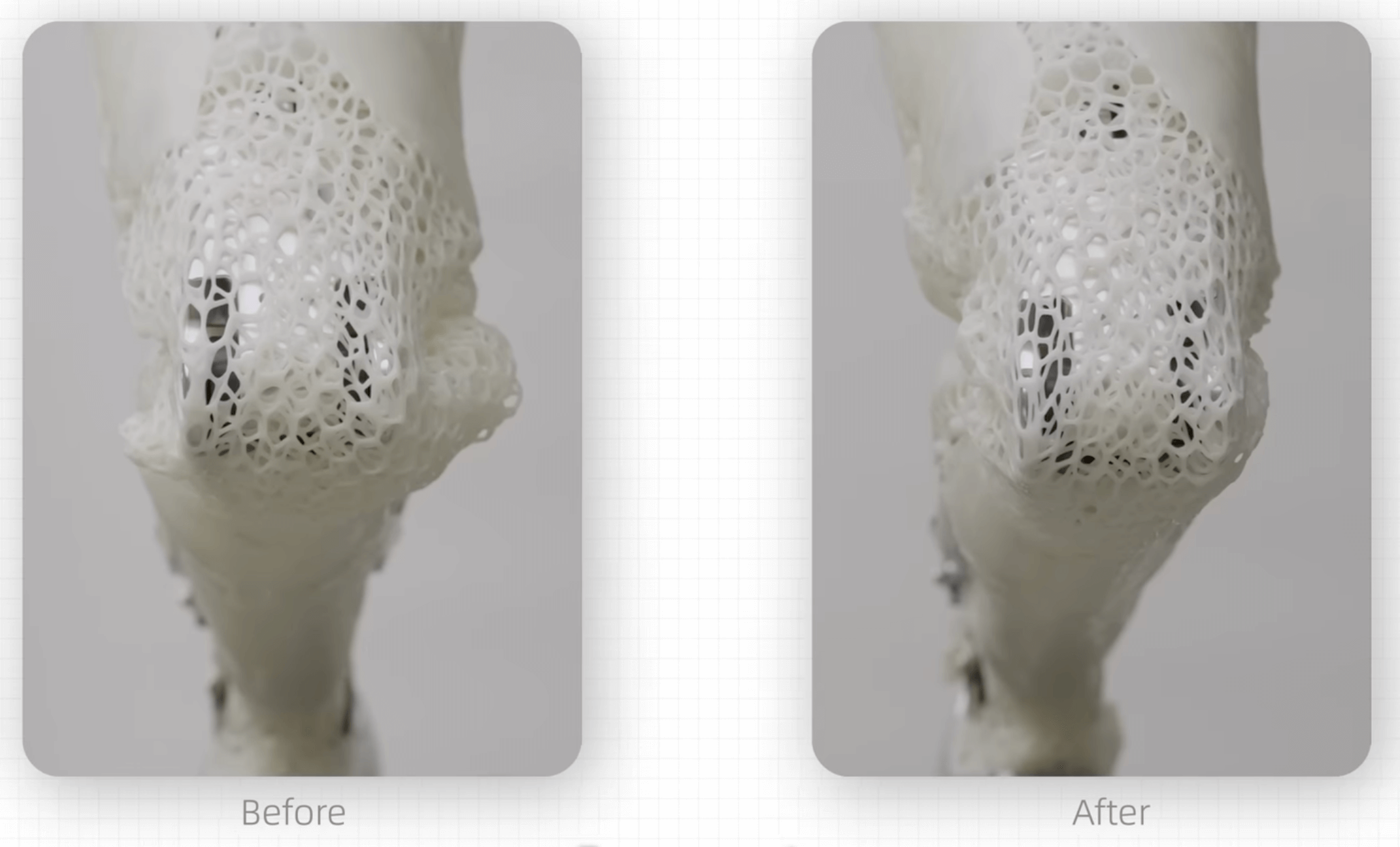
Xpeng Iron Synthetic Muscle
The Golden Ratio Meets Custom Actuators
Humanoid robots often develop exaggerated hips, thick thighs, or oversized joints for a simple reason: electric actuators occupy a lot of space. XPENG addressed that constraint by designing smaller custom actuators instead of relying on commercially available components. The reduced packaging allowed the engineering team to preserve the intended relationship between the waist, pelvis, and hips without enlarging the body simply to fit the hardware.
The company also introduced an unusual detail inside the leg joints. Rather than filling every joint with material, engineers left open cavities behind areas that compress during movement. When IRON bends its knees, the outer material has somewhere to deform instead of bunching outward. The leg maintains a smoother profile throughout the motion. It's a small mechanical decision, but it preserves the robot's shape while it moves and not just while it's standing still.
Building a Spine Instead of a Box
Human movement isn't generated by isolated joints. Walking, reaching, turning, and gesturing all involve coordinated motion across the pelvis, spine, shoulders, and neck. Many humanoid robots simplify this by treating the torso as a relatively rigid structure with only a few rotational joints. IRON takes a different approach.
XPENG designed a spine-like torso with additional degrees of freedom that allow the upper body and pelvis to move together. During walking, the hips can shift naturally beneath the torso. During gestures, the shoulders and spine contribute instead of relying entirely on the arms. Together they make the robot's posture appear less rigid. During XPENG's Technology Day demonstration, this was visible in the way IRON shifted its weight, rotated through its torso, and maintained balance while walking.
The same architecture also enables movements like shrugging, bending, nodding, and hugging without those actions appearing mechanically segmented.
Skin Designed as Part of the Mechanism
The skin covering IRON isn't simply cosmetic. XPENG designed it alongside the underlying lattice muscles and skeletal structure so all three layers deform together during movement. "The skin is not just a covering; it is what allows the robot's structures, movement, and visual expressions to finally feel like one coherent living form."
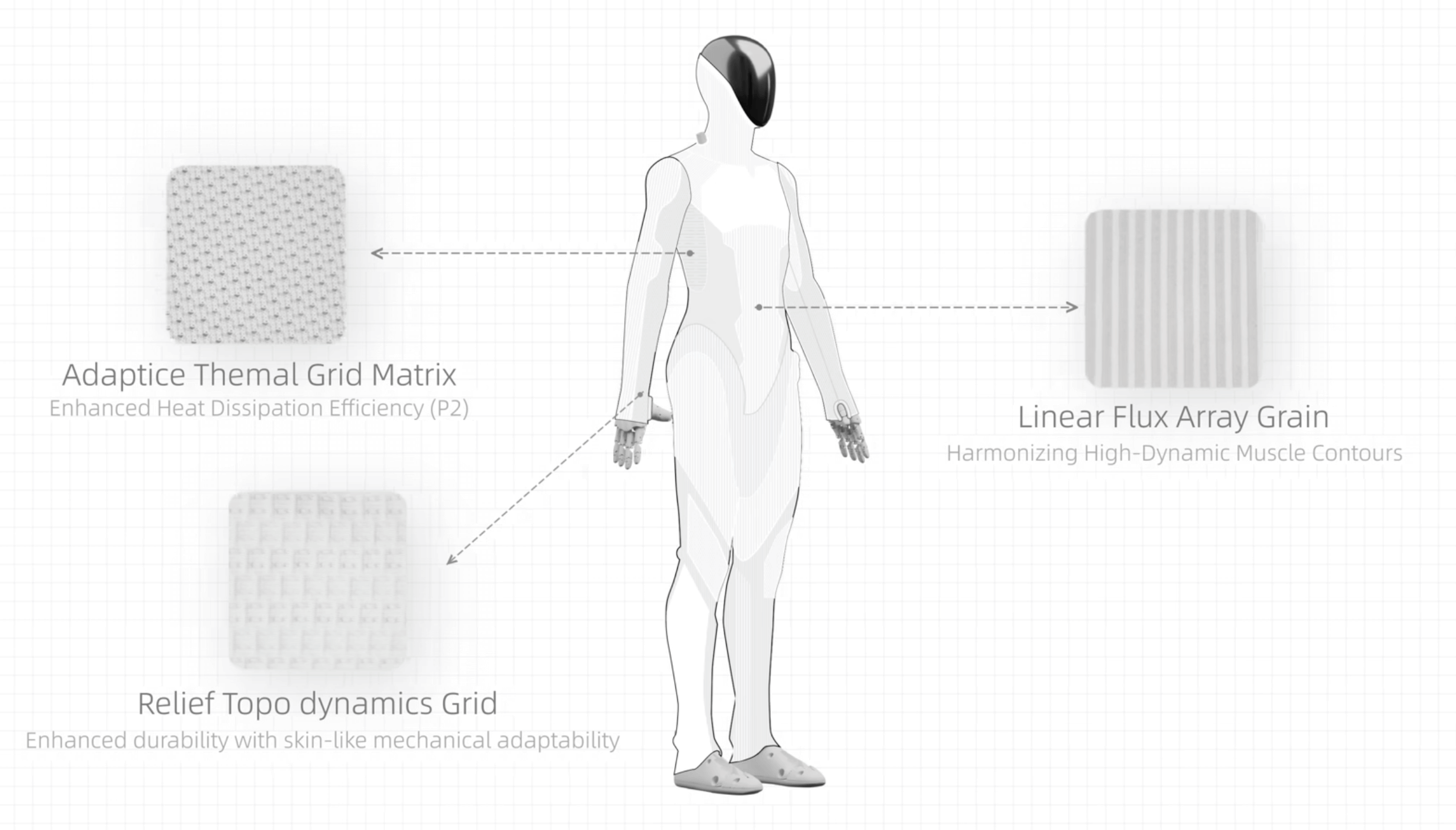
Xpeng Iron Synthetic Skin
Teaching Software to Understand Soft Bodies
The mechanical design introduced a new software problem. Traditional robot simulations assume rigid components whose physical properties remain relatively predictable. XPENG's lattice muscles behave differently. Their deformation is nonlinear, which makes accurate behavioral modelling much harder.
Without accurate models, reinforcement learning would train the robot on a simulation that doesn't match the real hardware. Motion controllers trained in simulation would produce unstable or awkward behavior once transferred to the robot. XPENG addressed this by collecting large amounts of dynamic motion data and developing proprietary system identification and reinforcement learning methods tailored specifically to its compliant structures.
The benefit extends beyond initial training. As the robot experiences wear, material fatigue, or gradual changes in its soft components, the control system is designed to remain stable despite those evolving physical characteristics. That's a requirement for any humanoid built around compliant materials rather than rigid mechanisms.
Conclusion: Rebuilding the Humanoid From the Inside Out
None of these ideas is entirely new on its own. Robotics researchers have explored compliant materials, spine mechanisms, custom actuators, and reinforcement learning for years. XPENG integrated all of them into a single platform.
The robot's skeleton was redesigned to preserve human kinematics. Custom actuators were developed to achieve human proportions. Lattice structures replaced conventional muscle materials. The skin became part of the mechanical system instead of a cosmetic layer. Even the reinforcement learning pipeline had to be adapted because standard rigid-body simulations no longer matched the hardware.
XPENG hasn't fully solved the uncanny valley. But they're pretty close — and getting there required rebuilding nearly every component from the skeleton to the software.