
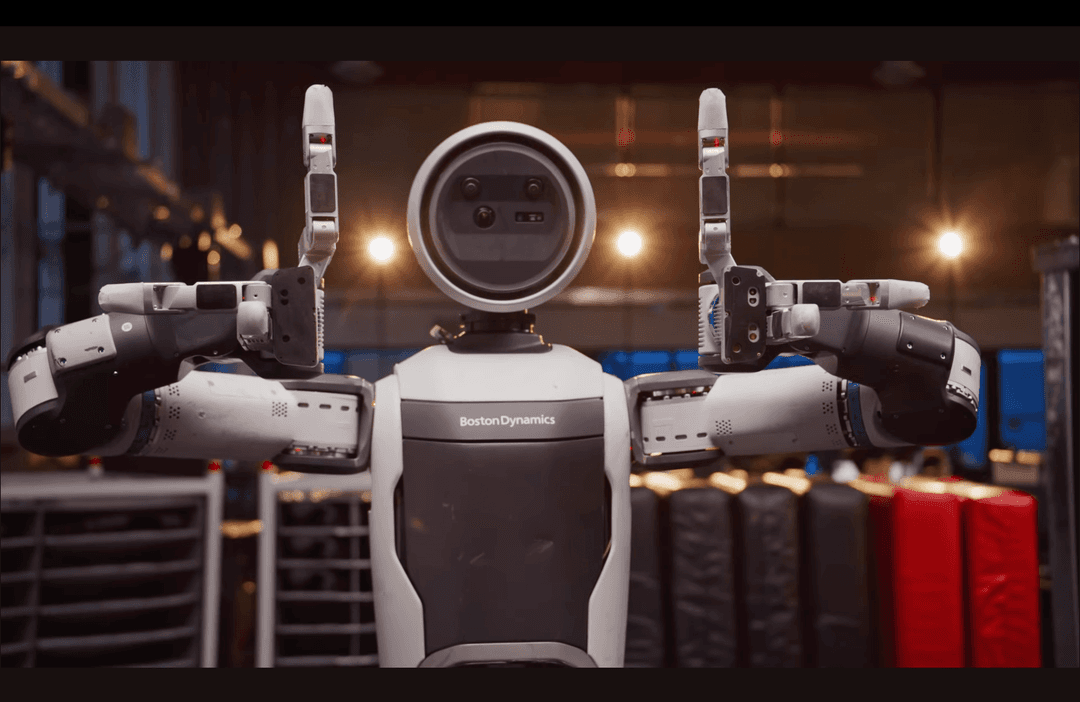
The "Uncanny Valley" Meets the Factory Floor
There is a distinct, visceral gap between seeing a robot on a backlit screen and standing in its physical presence. On YouTube, the fluid acrobatics of a humanoid can feel like high-end CGI—a digital trick designed for virality. But for Chris Thorne, who has spent over 15 years at Boston Dynamics, the reality of the new electric Atlas is far more arresting. He recalls the first time he encountered the finished hardware in the lab: "Your brain at first wants to say, 'This can't be real.' But then you realize, 'No, this is right in front of me.' I’m just getting goosebumps now thinking of that moment."
This isn't merely the thrill of a new toy; it is the realization of a transition from laboratory marvel to a hardened industrial tool. Alongside industrial designer Aaron Abbruff and compute lead James Cuso—a veteran who spent 12 years leading product design for Apple’s Mac division—Thorne is steering Atlas away from the realm of science fiction. This Atlas isn't a stunt double; it is a purpose-built worker designed to survive the grit of a manufacturing environment.
Not a Costume, But a Tool: Function Over Human Form
The most striking aspect of the new Atlas is its unapologetic rejection of the "mannequin" aesthetic. While the robot possesses "humanoid capability"—the ability to navigate and manipulate a world built for humans—it purposely avoids a literal humanoid form. Aaron Abbruff notes that the industry often traps itself in a nostalgia loop, trying to recreate the robots of 1970s cinema rather than designing for the 2030s.
A lot of companies... really want to make these robots look like the robots that they grew up with... which usually is something from a science fiction movie prop or a costume. And that's not really delivering on what a product needs to be.
By killing the sci-fi dream of a "person in a suit," Boston Dynamics has embraced an aesthetic of pure utility. This "purposeful" look signals that the machine is industrial equipment, not a novelty. It represents a shift in morphology where the robot's "bones" and "cladding" are dictated by the job at hand rather than an attempt to mimic human anatomy.
The Actuator Revolution: Modularity as a Superpower
The foundation of this new morphology is custom actuation technology that is 2 to 5 times more performant than anything available off-the-shelf. This extreme power density allowed the team to move away from specialized, unique joints in favor of a modular architecture. This isn't just an engineering win; it’s a business strategy.
This modularity enables a radical "reuse" philosophy:
Engineering Reliability
By concentrating on just two types of motors that can be used in almost any joint, the team can find and fix failures across a massive pool of identical parts, accelerating the path to robustness.
Manufacturing Scale
Sourcing fewer component types allows for better economies of scale and simplified assembly, moving the robot closer to mass production.
Serviceability Strategy
In a factory setting, downtime is the enemy. Modularity allows for "limb swapping" where a damaged arm or leg can be replaced in minutes, with only two motor types needed in the spare parts inventory.
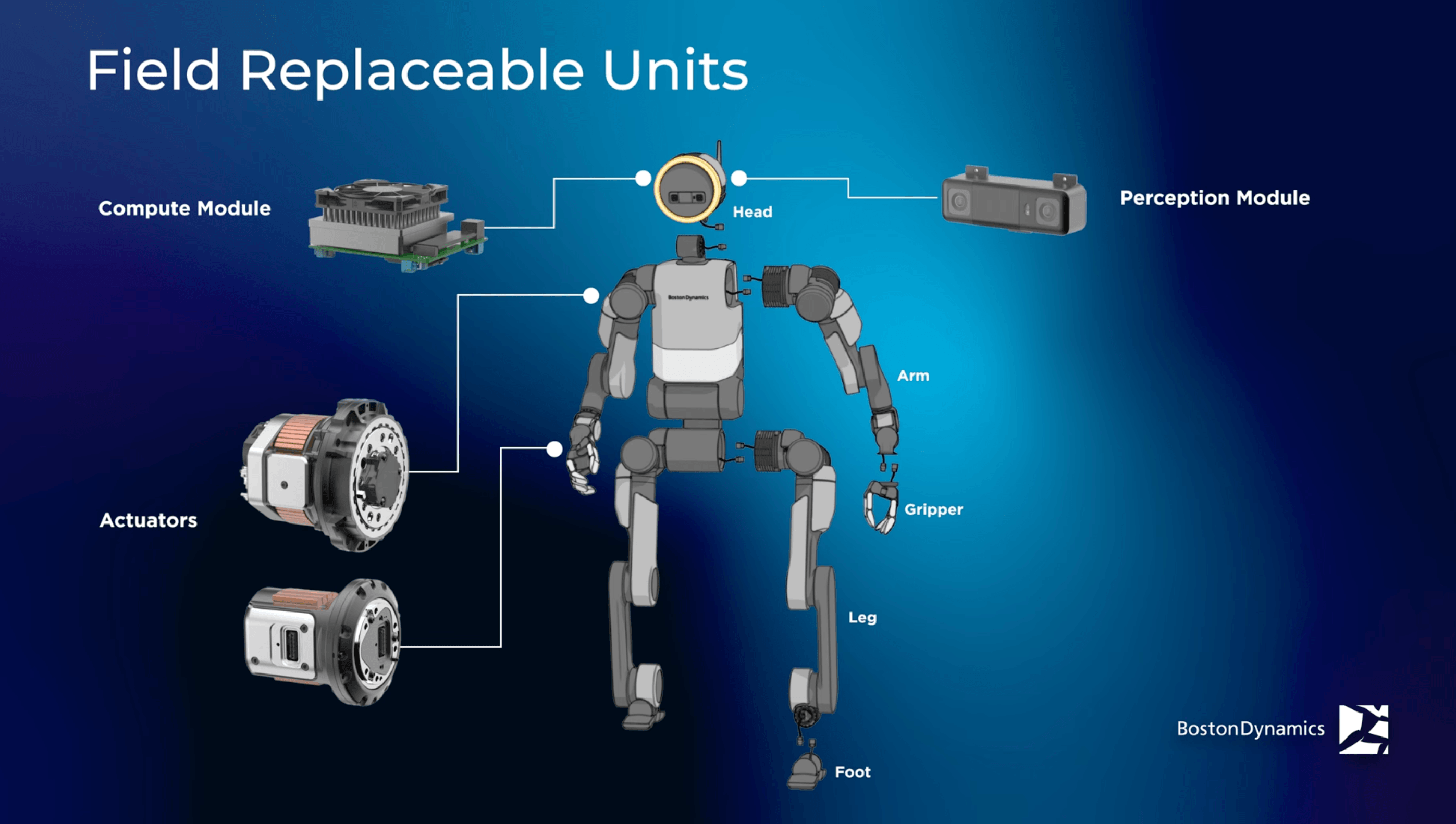
Atlas humanoid robot design (Image credit: Boston Dynamics)
This modularity also unlocks an "inhuman" Range of Motion (ROM). Abbruff uses a "snow angel" analogy to describe it: while a human's arms eventually hit their head or hips, Atlas's actuators and symmetrical limbs allow it to move through planes of motion that would be physically impossible for a person, maximizing where it can place its grippers in space.
The 24/7 Workhorse: Why Atlas Swaps Its Own Batteries
For partners like Hyundai, a robot is only as valuable as its uptime. In general assembly lines, work is constant. This requirement forced the team to reject the industry standard of fast charging, which would strain the local power grid and force robots into "nap cycles." Instead, Atlas is designed to swap its own batteries.
To achieve this 24/7 operational cycle, the design team chose to place the batteries prominently on the exterior rather than burying them under a sleek, inaccessible skin. This is the "utilitarian gestalt" in action: the robot’s appearance is defined by its need to reach back, grab a fresh power pack, and replace it itself. It is a design choice that favors productivity over a clean, unbroken silhouette.
Functional Aesthetics: Cooling Fins and Offset Links
The high power density of the Atlas motors generates immense thermal energy. Rather than relying on a fleet of noisy, failure-prone fans, the team opted for passive cooling. The cooling fins visible on the robot’s limbs emerged late in the project as a thermal necessity, but they were ultimately embraced as a core "cosmetic" element of its industrial language.
Safety, however, was the ultimate architect of the robot’s proportions. To prevent "pinch points" or entrapment for human handlers, the team enforced a strict "one-inch gap" rule for all moving parts.
Offset Links: To maintain safety without sacrificing ROM, the team utilized "offset links" in the knees and elbows.
Non-Human Proportions: These offsets and safety gaps make the robot wider and taller than a typical human.
This is a key design argument: the departure from a human silhouette wasn't a failure of imagination, but a triumph of safety engineering. By making the robot wider and "weird-looking" at the joints, they created a machine that is safer to work alongside than a literal humanoid mimic.
The Head: A Computer with a "Halo," Not a Face
The head of the Atlas is a masterpiece of ruggedized UX. James Cuso, drawing on his 12 years at Apple, describes the head as a "high-performance computer on a neck." Despite having worked on over 30 personal computers, Cuso calls this the most challenging project of his career. The head must pack the punch of a desktop workstation into a waterproof, impact-resistant shell.
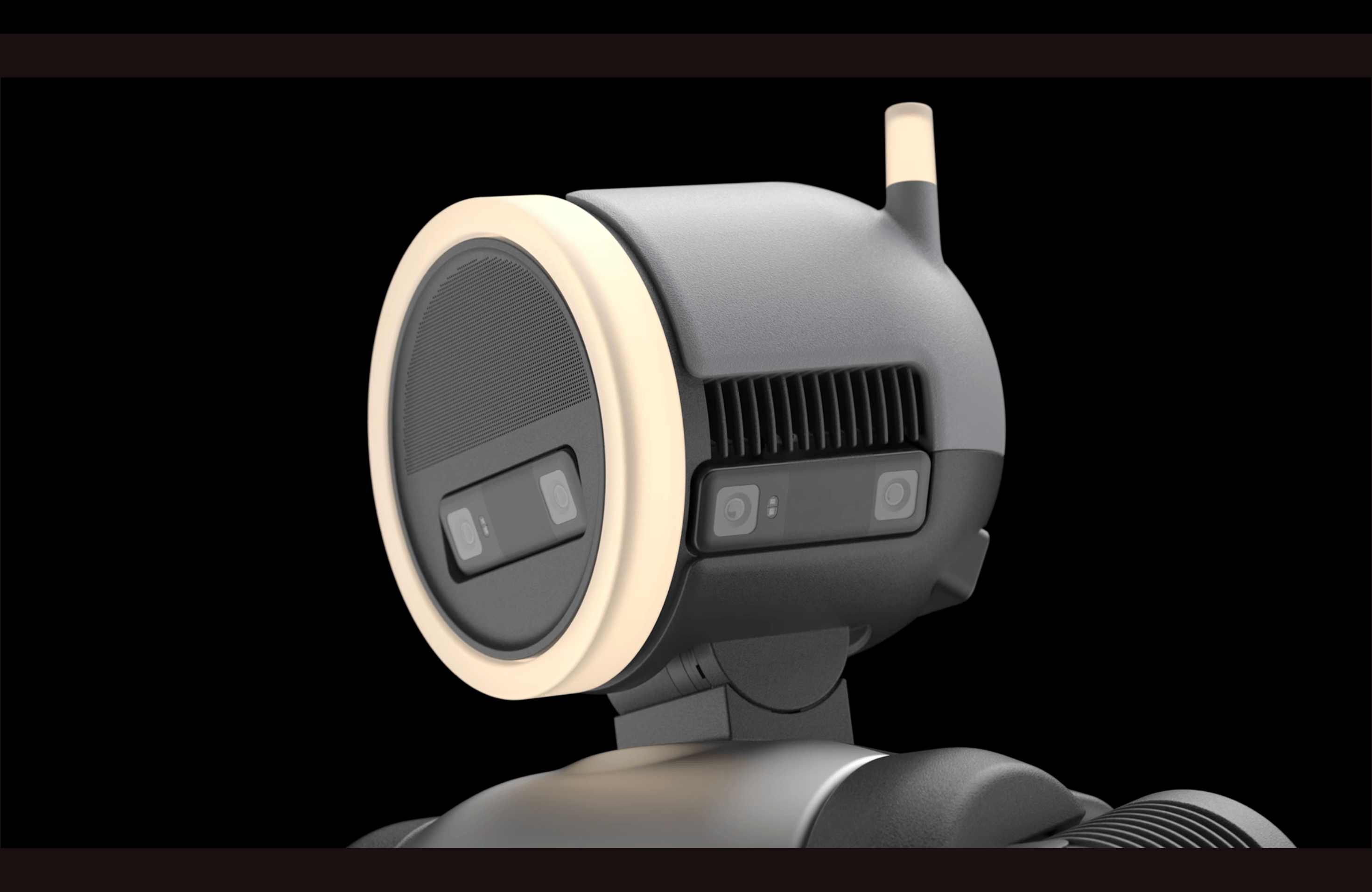
Atlas humanoid robot design (Image credit: Boston Dynamics)
Instead of uncanny eyes, the head features a thick silicone "halo" light ring, complemented by a rear light ring and an antenna-style mast light. These provide a clear, iconic interface for human-robot interaction without falling into the Uncanny Valley. Mechanically, the head includes a 10-degree "neck pitch"—a subtle nod that is technically necessary for perception, allowing the robot to look down at its own feet or up at high warehouse shelving.
Creating a very performing computer that's also waterproof is a really tough challenge... it needs to be able to survive a humanoid robot potentially tripping and falling from two meters in height and impacting the edge of a table."
Conclusion: Designing for the 2030s
Standing in 2026, the Boston Dynamics team is essentially designing hardware for behaviors that won't fully exist until 2028 or 2030. This "future-proofing" is only possible through the modularity they have championed. If a new AI model in 2029 requires a different sensor suite or a more dexterous limb, the robot’s architecture allows for a phased hardware intercept rather than a total redesign.
Atlas proves that the future of the factory floor doesn't look like a person in a metal suit. It looks like "humanoid-plus"—a machine that respects the human environment while transcending the limitations of the human form. As we move into the next decade, the question is no longer whether a robot can look like us, but why we ever wanted it to, when it could be something so much more functional.