
Atlas (Electric)
Enterprise-grade electric humanoid for industrial automation
Contact for Pricing
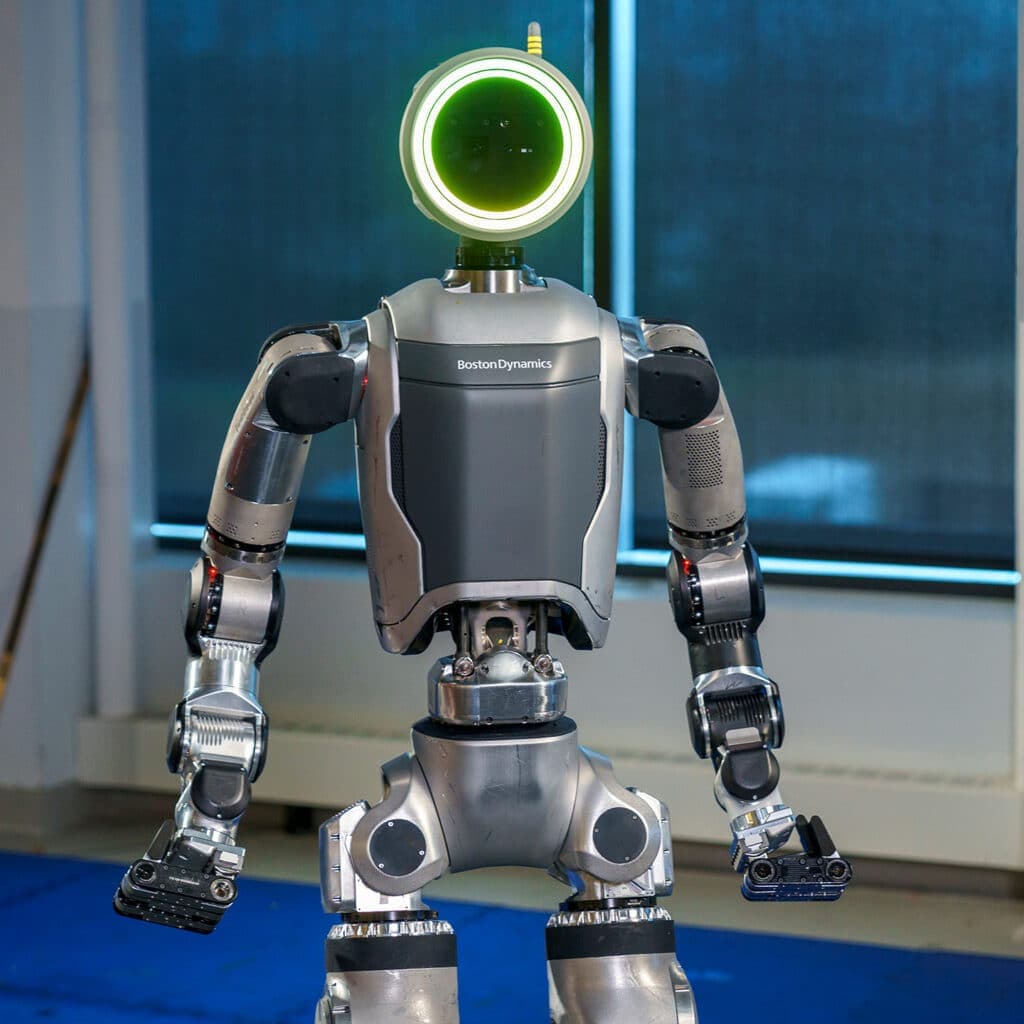
Technical Details
Specifications
| Height | 1.9 m / 6' 3'' |
|---|---|
| Weight | 90 kg / 198.4 lb |
| Degrees of Freedom | 56 |
| Locomotion | biped |
| Payload | 50 kg |
| Battery Type | — |
| Speed | 2.46 m/s |
| Rated Runtime | 4 h |
Sensors
| Cameras | RGB |
|---|---|
| Depth Sensing | Yes |
| Lidar | Not disclosed |
| IMU | Yes |
| Microphones | Not disclosed |
| Tactile Sensing | hands + body (360° perception) |
Software
| Control Mode | autonomous, teleoperation, hybrid |
|---|---|
| Middleware | — |
| SDK | Proprietary |
| SDK Details | Enterprise integrations, simulation, teleop |
| Connectivity | Wi-Fi |
Deployment
Units Shipped: Not publicly disclosed
As of Jul 2026
Company Claim
Per Reuters (Jan 5, 2026), Hyundai said it aims to build a factory capable of manufacturing 30,000 Atlas units annually by 2028, with robots initially carrying out parts sequencing from 2028, expanding to component assembly by 2030, and eventually to heavier, more repetitive tasks. A more specific fleet figure of "more than 25,000" units has circulated widely in trade press, attributed to a May 2026 JPMorgan investor session and originating with The Korea Times — not independently confirmed via Reuters or another top-tier outlet, and excluded from this record's confirmed figures pending that confirmation
What's Actually Confirmed
Per Hyundai's own July 16, 2026 statement (made the same week as a worker strike over the issue), Atlas had not been assigned a single task at any Korean Hyundai plant. The 2028 timeline and 30,000-unit annual capacity target are stated commitments, not a completed or in-progress deployment
Hyundai Robotics Metaplant Application Center (RMAC)
United States (Hyundai Motor Group facility; exact site not specified in available sources)
| Task | Application development and testing ahead of eventual factory deployment |
|---|---|
| Stage | Training |
| Start Date | Jan 2026 |
| End Date | — |
Google DeepMind
Not specified
| Task | AI research and development — integrating DeepMind foundation models into Atlas |
|---|---|
| Stage | Training |
| Start Date | Jan 2026 |
| End Date | — |
Hyundai Motor Group Metaplant America (HMGMA)
Savannah, Georgia, USA
| Task | Parts sequencing (initial phase); planned expansion to component assembly by 2030, then repetitive/heavy-load tasks |
|---|---|
| Stage | Agreement |
| Start Date | 2028 |
| End Date | — |
Frequently Asked Questions
What is the Atlas (Electric) and who makes it?
Atlas (Electric) is an enterprise-grade electric humanoid for industrial automation. It is manufactured by Boston Dynamics and was announced in 2026.
How tall is the Atlas (Electric)?
Atlas (Electric) is 1.9 m / 6' 3'' tall.
How much does the Atlas (Electric) weigh?
Atlas (Electric) weighs 90 kg / 198.4 lb.
How much can the Atlas (Electric) carry?
Atlas (Electric) can carry a payload of 50 kg.
How much does the Atlas (Electric) cost? Is the Atlas (Electric) available to buy?
Boston Dynamics has not published a price for the Atlas (Electric) — it is quoted on enquiry. Not commercially available. Entire 2026 production run committed to Hyundai and Google DeepMind; additional customers expected from 2027.
What are the main strengths of the Atlas (Electric)?
- Fully electric architecture enabling industrial scalability
- High payload and reach for real factory tasks
- 56 DoF with full rotational joints enabling superior dexterity
- Autonomous battery swapping enabling near-continuous operation
- Strong enterprise integration (Orbit fleet management, MES/WMS connectivity)
- Backed by a well-resourced parent company (Hyundai Motor Group) — see Boston Dynamics' manufacturer profile for ownership details
What are the limitations of the Atlas (Electric)?
- Limited transparency on AI stack and compute
- Unknown cost structure at scale; no confirmed public price
- Manipulation reliability at production scale unproven
- General-purpose autonomy still dependent on teleoperation and training pipelines
- No unit assigned to a task at any Korean Hyundai plant as of mid-2026; actual factory-floor use not planned until 2028
- Deployment plans face active labor opposition at Hyundai's largest complex (Ulsan)
Related Humanoids


Last updated: Aug 2026