
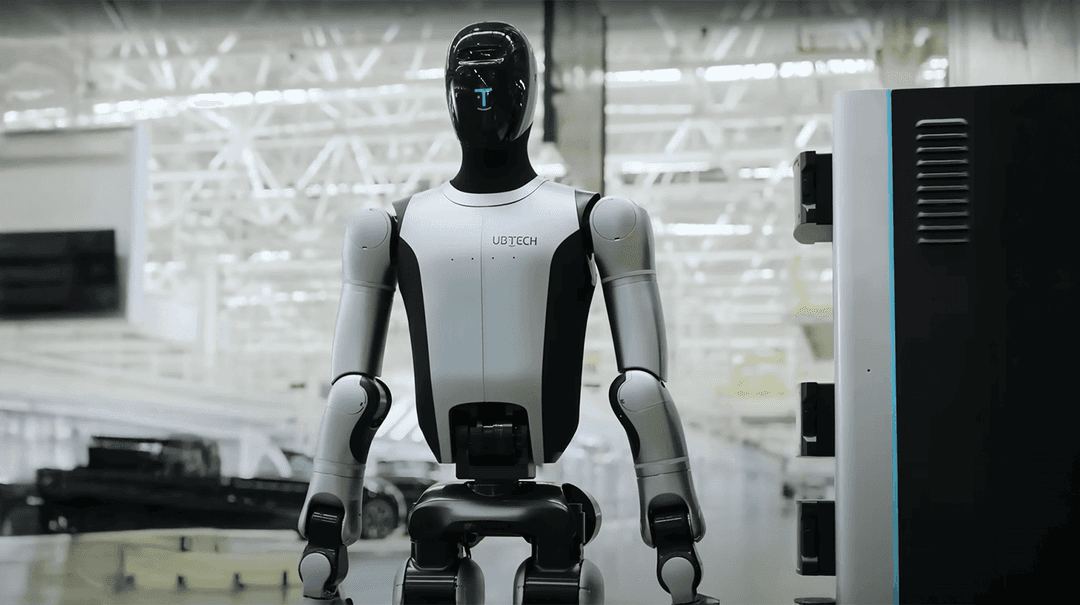
Most humanoid robots have a charging problem. They run for a couple of hours, then sit plugged in for longer than they worked. Walker S2 has a different answer to that: it swaps its own batteries.
The Headline Feature: Autonomous Battery-Swapping System
The system uses two 48-volt lithium modules. One runs the robot while the other charges or waits in a bay. When power gets low, Walker S2 walks to the battery station, pulls the spent pack, slots in a fresh one — unassisted, without shutting down — in about 3 minutes. It also monitors charge in real time and decides whether to swap or top up based on whatever task it's in the middle of. That's UBTECH's claim, at least.
Watch Walker S2 swap its battery in 30 seconds:
Why it works
The charging bottleneck is one of the more mundane reasons humanoid robots haven't made it off the demo floor. A robot that needs 90 minutes of downtime for every 2 hours of work doesn't fit neatly into a factory running 24/7 shifts. Autonomous swapping, if it holds up, chips away at that. A few specific things it changes:
- Reduced downtime. No human needed to plug it in, wheel it to a charging dock, or babysit the process. The robot sorts its own power.
- Scheduling flexibility. It can weigh task priority against battery level and choose accordingly — charge now or swap and keep working.
- Redundancy. The dual-battery design means one module can cover if the other fails mid-task. There's also a safe hot-swap mechanism so it doesn't need a full shutdown to make the switch.
- Industrial fit. Uptime is everything in manufacturing and logistics. This directly addresses one of the loudest complaints from factory operators looking at humanoids.
What it doesn't solve
The runtime without swapping is still modest. One source puts it at roughly 2 hours of walking or 4 hours of standing per module. If no charged pack is available, a full recharge takes around 90 minutes. So the swap system only works if the infrastructure around it works too. And that infrastructure — the battery bay, the swap station, the integration with the facility's systems — has to be installed, maintained, and paid for. That adds cost and complexity before the robot does a single task.
The deeper question is long-term reliability. The swap mechanism works in demos. Whether it holds up across thousands of cycles in a dusty, vibration-heavy factory floor is something UBTECH hasn't shown publicly yet. And for operations where the task load doesn't justify the extra hardware, a cheaper fixed-charge robot might still make more economic sense.
Other Notable Capabilities
Payload and manipulation. Walker S2 handles up to 15 kg within a 0–1.8 m workspace. A high-torque waist servo gives it ±162° rotation — so it can reach across its body, down to the ground, or behind itself without moving its feet.
Vision. It uses a pure RGB binocular stereo vision system with deep-learning depth estimation. No LiDAR, no depth camera — just two RGB cameras and software doing the geometry. That's a design choice worth watching in real factory conditions.
Mobility. 52 degrees of freedom across the body. It walks, squats (pitch up to ~170°), and reaches in ways that mirror human movement. That's the point — environments built for people don't need to be modified for it.
AI and coordination. Walker S2 runs UBTECH's BrainNet 2.0 and Co-Agent stack for task planning and multi-robot coordination. The swarm intelligence layer lets multiple Walker units (both bipedal and wheeled robots) share environmental data and route around each other. One robot maps a blocked aisle; the others reroute.
Known Deployments
UBTECH says the Walker S series is deployed in more automotive factories than any other humanoid robot. That's their claim. Here's what's verifiable:
Zeekr (Geely Auto), Ningbo, China. Dozens of Walker S1 robots deployed in Zeekr's 5G smart factory for sorting, handling, and precision assembly. One source reports a Walker S Lite variant ran for 21 consecutive days in a training context, collaborating with AGVs and AMRs. UBTECH calls this the first humanoid robot team deployed in a Chinese automotive factory.
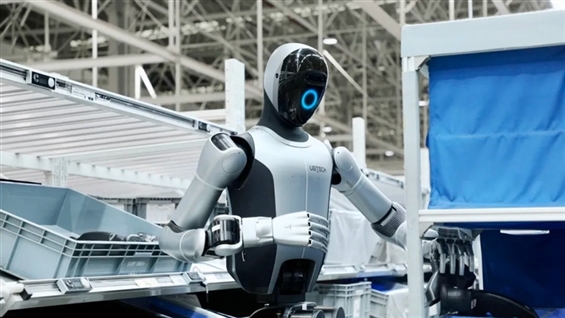
Walker in a Zeekr factory
NIO, assembly and inspection. Walker S robots were put through training at a NIO NEV assembly line to automaate quality inspection of door locks, headlight covers, seat belts. UBTECH shared the video. The status reads as training and pilot, not full production deployment.
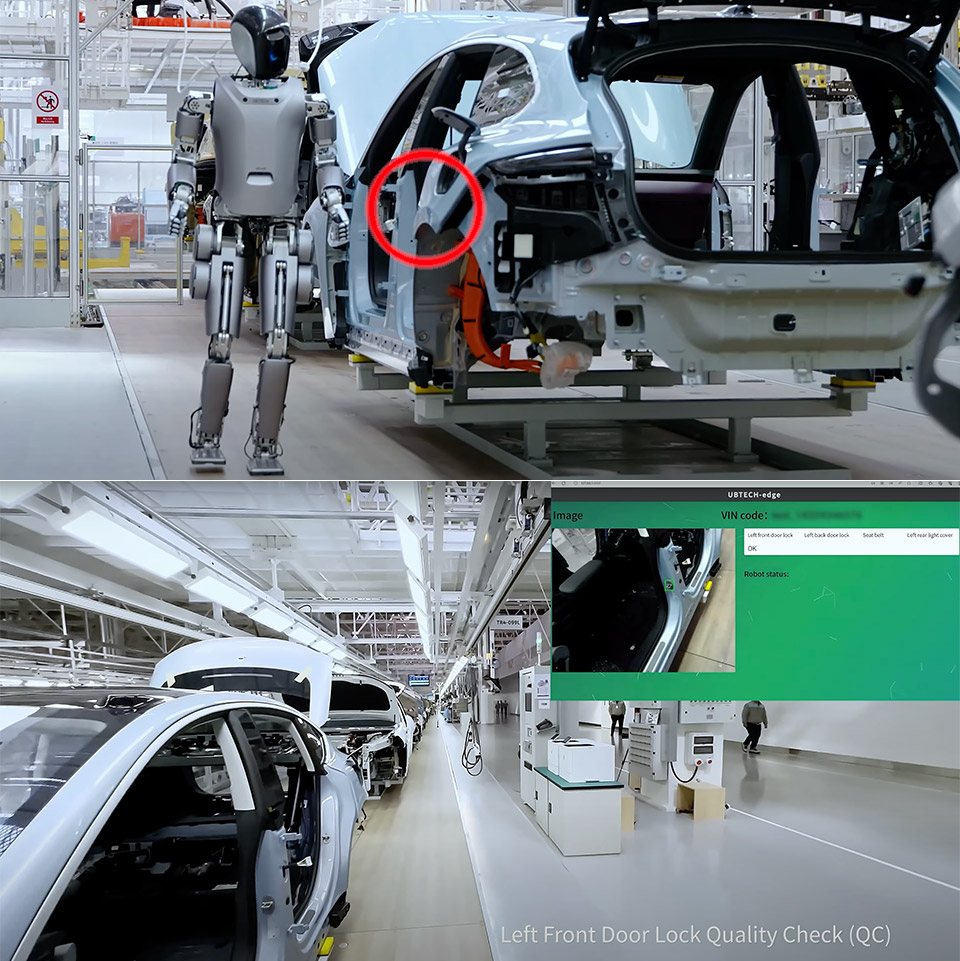
Walker working on NIO production line
Dongfeng Liuzhou Motor. UBTECH signed a strategic cooperation agreement to introduce Walker S into their factory. Planned tasks include seat belt and door lock inspection, body quality checks, oil-filling, front-axle packaging, material handling, and labelling. Currently at agreement and training phase — full deployment scale not confirmed.
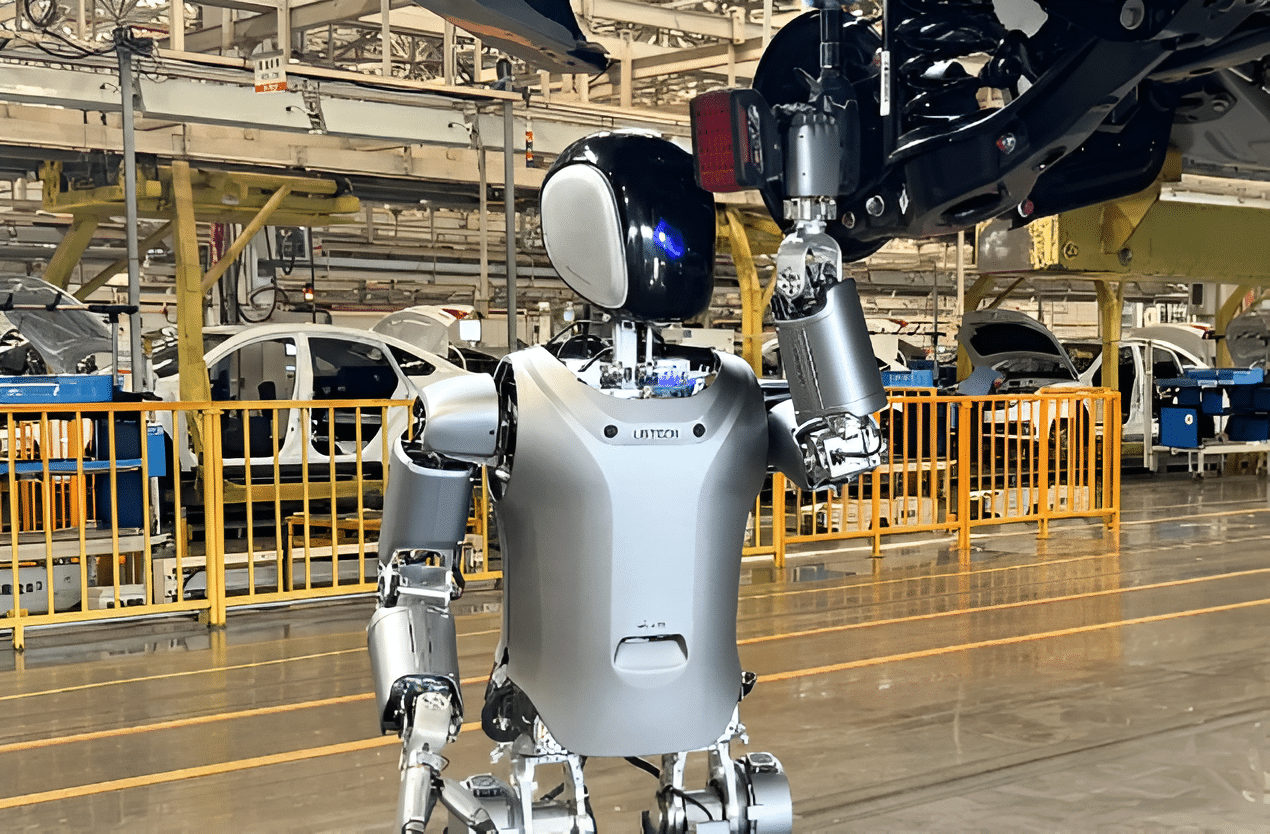
Walker working in Dongfeng automotive manufacturing plant
BYD, logistics integration. Walker S1 was part of a full-stack unmanned logistics solution at BYD, collaborating with AMRs, AGVs, and the factory MES. Tasks: sorting, handling, and indoor/outdoor distribution. The integration with wheeled robots and warehouse systems is the notable part here.

Walker on a factory floor
UBTECH's delivery target is 500–1,000 Walker S series units to industrial customers by end of 2025.
Outlook
The battery-swap capability is genuinely interesting. Not because it's flashy, but because it attacks a real operational problem that most humanoid developers have quietly left unsolved. If Walker S2 can run continuously with minimal intervention in a real factory (not a staged demo) it clears a bar that most humanoids haven't reached.
The honest version of the story is: the technology works in controlled conditions, the deployments so far are mostly training and pilot phases, and the economics at scale are unproven. UBTECH needs to get to hundreds of units in active production use — not agreement-and-training phases — before the claim of "deployed in more automotive factories than any other humanoid" means what it sounds like it means.
That might happen. They're closer than most. But "closer than most" and "actually works at scale" are still different things.