
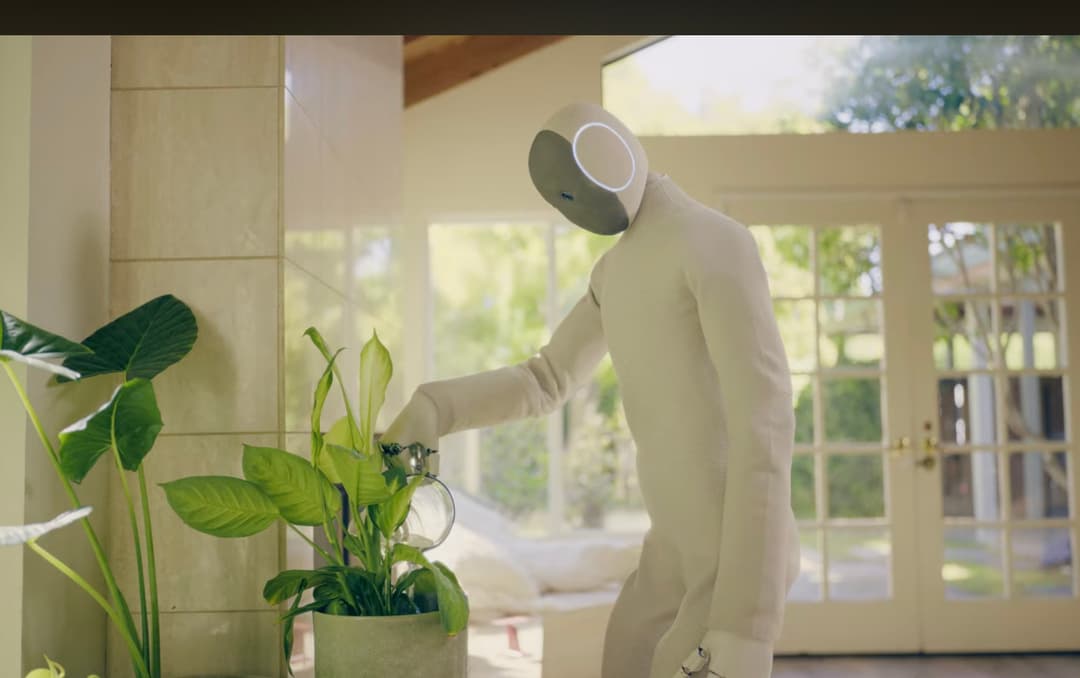
A robot that actually does your laundry — not in a lab, not in a demo reel, in your house. That's what 1X is selling with NEO. Whether it delivers is a different question.
Headline Feature: Automated Housework
You give NEO a list of tasks or tell it what needs cleaning, and it wanders around your home to get the work done. Fold laundry, organise shelves, empty the dishwasher, vacuum floors, pour you a coffee. You can schedule jobs through an app or by voice command. Unlike most robots in this space, NEO wears a soft fabric cover and has a deliberately neutral, friendly look. Its materials and low-impact motors are designed so it won't hurt people — that's a core safety focus, not marketing copy. It's built to be gentle in a home, which matters when it's moving through a space full of children, pets, and furniture that doesn't move in straight lines.
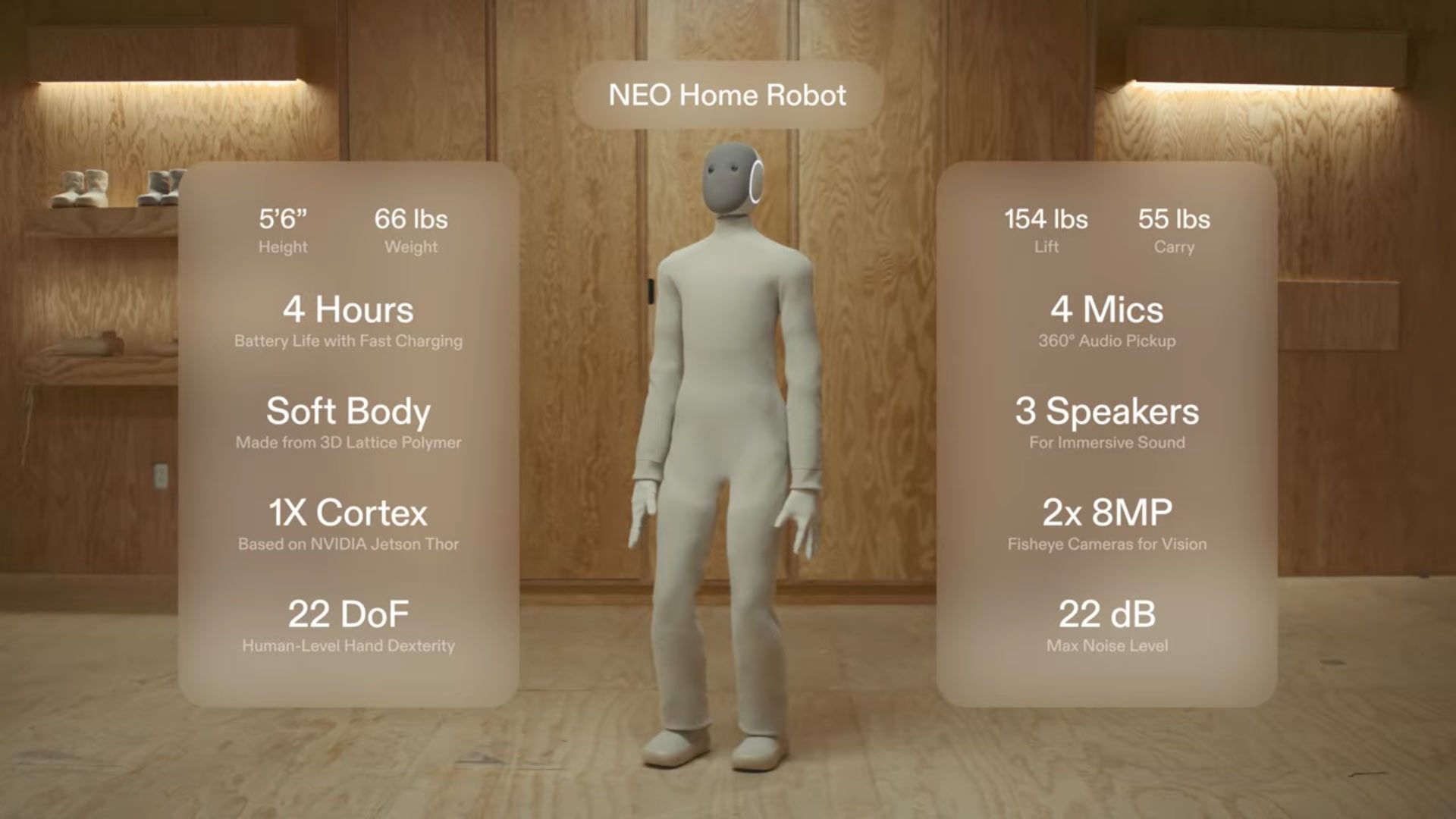
NEO Home Robot Specs (Image Credit: 1X Technologies
Why it works
1X says NEO gives you "back valuable time and mental space." That's the pitch. If it works, you stop spending Saturday mornings tidying and NEO handles it instead — routine stuff like sweeping, folding laundry, organising. Hours back every week. That's real, if the robot does what it says.
What it doesn't solve
NEO's biggest limitation right now isn't technical — it's that someone at 1X might be watching through its camera while it learns your home. That's the deal with "expert mode": when NEO encounters a new or complex task, a 1X operator watches through the robot's camera and guides it in real time. For anything outside its basic skill set, a 1X engineer is essentially looking around your house. The Wall Street Journal piece — "I Tried the First Humanoid Home Robot. It Got Weird." — revealed that more complex tasks were handled by a tele-operator entirely, which raises privacy questions that 1X hasn't fully answered.
NEO also learns over time, not instantly. Early performance won't be flawless. And it's strictly indoor-only for now — no lawn mowing, no cooking. Whether a more autonomous version arrives in 2026, when the robot is scheduled to ship, is something we'll find out.
Other Notable Capabilities
Human-like handling. NEO uses a tendon-drive motor system that makes its arms smooth and strong. Each hand has 22 degrees of freedom and the robot can lift over 150 pounds — yet moves gently enough to be safe around people. It runs at around 22 decibels, quieter than a refrigerator.
Senses and AI. NEO has cameras for vision and a built-in language AI. It can recognise ingredients on a kitchen counter, answer questions, and remember past conversations. Alexa on two legs. It hears through four microphones, speaks through three speakers, and runs its own custom AI model to decide what to do next.
Navigation and autonomy. NEO walks, climbs stairs, and — usefully — finds its own charger and plugs itself in when the battery runs low. On a full charge it runs for about four hours. The self-charging is one of the cleaner demos: it locates a wall outlet and plugs in without any help.
Connectivity and home integration. It connects via Wi-Fi, 5G, or Bluetooth, controllable through a phone app or by voice from anywhere. There are also speakers built into the torso for playing music or podcasts — a detail that feels more lifestyle accessory than robot, but there it is.
Known Deployment Cases
Beta testing in homes (2024). Earlier versions — called NEO Beta — went into a small number of real houses in late 2024. 1X used that data to improve NEO's software and safety before moving toward a consumer product.
Demo videos (2025). Throughout 2025, 1X and the press have shown NEO carrying laundry baskets, serving drinks, cleaning kitchens, and climbing stairs. These are staged demos, not deployed products — worth keeping in mind when watching them.
Pre-order launch (late 2025). As of October 2025, 1X has opened pre-orders. Early adopters in the US can reserve NEO with a deposit; early-access price is $20,000, with delivery planned for 2026. There's also a subscription plan at $499 per month. The product is moving from prototype to real market, at least on paper.
There is a not-so-distant future where we all have our own robot helper at home… But for humanoid robots to truly integrate into everyday life, they must be developed alongside humans, not in isolation.”
— Bernt Børnich, CEO of 1X
Outlook
NEO is the furthest along any home humanoid has gotten. That's worth saying plainly. It's also $20,000, currently needs a human in the loop for hard tasks, and ships in 2026 — according to 1X. There's a version of this story where it works: early adopters deal with the rough edges, the model improves, and by 2027 it's actually doing your laundry without someone watching through a camera. There's also a version where you spend two years training a $20,000 robot that still can't fold a weird jacket.
The question isn't whether NEO is impressive. It is. The question is whether the gap between the demo and the reality is the size of a software update — or a decade.