
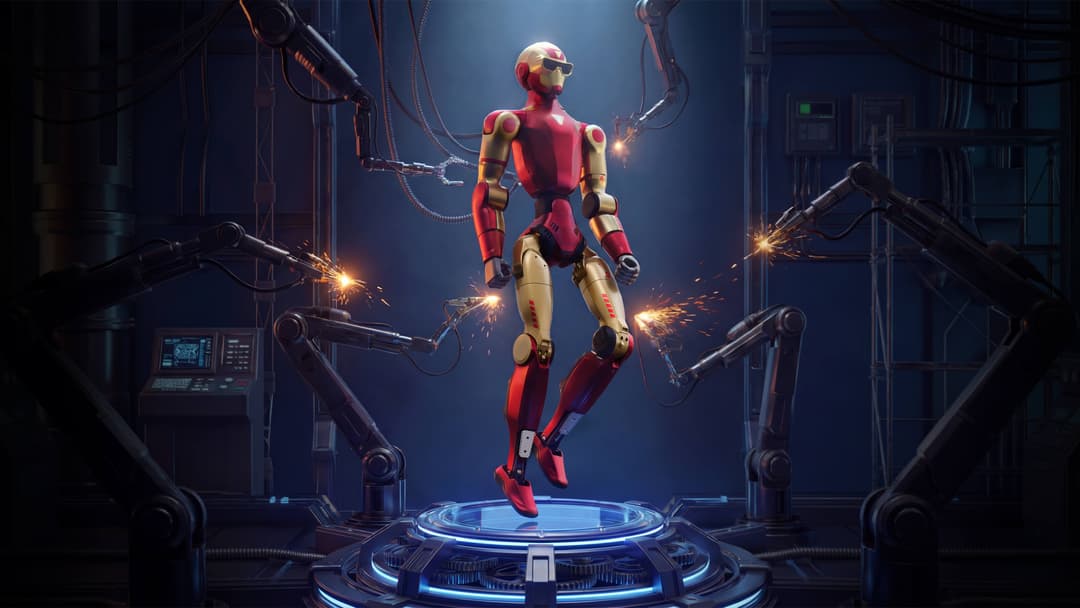
The most disruptive product launch of 2026 isn't a new iPhone or an electric car.
It's a humanoid robot. Available right now. For less than $5,000.
Unitree Robotics just listed its R1 humanoid robot for sale on their website. It walks. It runs. It does cartwheels. And it starts shipping in June 2026 to customers in North America, Europe, Japan, Singapore, and the UAE.
The price? $4,900 for the base model. Less than a high-end laptop.
The Robot That Just Broke the Entire Industry
To understand why this launch is such a bombshell, you need to know what humanoid robots used to cost.
Until recently, a functional humanoid robot ran $300,000 on average for industrial-grade models. Even Unitree's own premium G1 model costs between $13,500 and $16,000—and balloons to $27,300 in the US after tariffs.
The R1 blows all of that up. Detailed technical specs here.
And the market is noticing. In 2025, Unitree shipped 5,500 humanoid robots. Their rivals—Tesla, Figure AI, Agility Robotics—shipped fewer than 150 units each. Unitree is now targeting 10,000 to 20,000 units in 2026.
How Do You Sell a Robot for $4,900? Cut Everything That's Expensive
The R1 is a masterclass in aggressive cost-cutting. Some cuts are smart. Some are worth knowing about before you buy.
What you get:
- A 121-centimeter humanoid robot weighing 27–29 kg
- Up to 26 degrees of freedom (meaning 26 independently moving joints)
- Ultra-wide binocular cameras for vision
- A 4-microphone array and dual speakers
- WiFi 6 and Bluetooth 5.2
- An 8-core CPU, with an optional NVIDIA Jetson Orin upgrade for the developer version
Functional Variants:
- Standard R1: This is the most affordable version, starting at approximately $4,900 to $5,900 USD. It is primarily a manually operated robot that does not support secondary development.
- Configuration Sub-variants: R1 Air: Available in White or Red. R1: Available in White or Red.
- R1 EDU: This version is tailored for developers and researchers. Unlike the standard model, it supports secondary development and allows for significant hardware customization. To purchase this edition, customers must contact the Unitree sales team directly.
- According to the Unitree official pre-sale listings, the standard model includes the following specific options
What got cut to hit the price:
The R1 drops the 3D LiDAR sensor found on the premium G1, replacing it with cameras. The G1's knee joints generate 90 Newton-meters of torque — enough for serious physical tasks. The R1's arm joints max out at 2kg of torque. Capable, but lighter-duty.
Battery life is one hour, versus the G1's two hours. And while the G1 uses dual encoders on every joint for precise position correction, the R1 mixes single and dual encoders to save money.
None of these compromises are dealbreakers for most developers and early adopters. The robot can still do cartwheels, run across uneven terrain, and recover from falls — Unitree calls this the "Born for Sport" design philosophy, built around low-inertia motors that prioritize fast response over raw power. For $4,900, it's remarkable hardware.
R1 vs. G1: Which One Should You Actually Buy?
If you're a developer, researcher, or early adopter still considering a Unitree robot despite all of the above, here's how the two models compare:
| Feature | R1 (Mass-Market) | G1 (Developer Flagship) |
|---|---|---|
| Price (US, after tariffs) | ~$4,900–$5,900 | ~$27,300 |
| Height | 121–123 cm | 132 cm |
| Battery life | ~1 hour | ~2 hours |
| Vision | Binocular cameras | 3D LiDAR + depth camera |
| Max torque (knee) | Limited | 90 Nm |
| Security vulnerabilities | Yes | Yes |
| Unauthorized telemetry | Yes | Yes |
The G1's LiDAR, longer battery, and higher torque make it the right choice for serious industrial or research use — if you can stomach the price. The R1's appeal is its accessibility. It's the robot for developers and early adopters who want to build and experiment without a six-figure budget.
Both carry identical security risks. Read more here.
Why Unitree Can Sell Robots This Cheaply — And Why That Matters
The $4,900 price tag isn't a loss leader or a marketing gimmick. It's the result of a supply chain advantage that Western robotics companies genuinely cannot match.
Over 80% of Unitree's components are sourced within China. That vertical integration eliminates the international shipping costs, currency risks, and procurement delays that inflate prices for competitors still relying on global supply chains.
And Unitree is using a distribution model nobody in robotics has tried before. Instead of enterprise sales teams and eight-month procurement cycles, they listed their robots directly on AliExpress — with free shipping and returns in many regions. They've opened offices in London, Dublin, and Dubai to handle local market entry.
It's Amazon Prime logic applied to humanoid robots. Click. Buy. Delivered.
The strategy is working. Unitree shipped more humanoid robots in 2025 than every Western competitor combined — by a factor of roughly 37.