
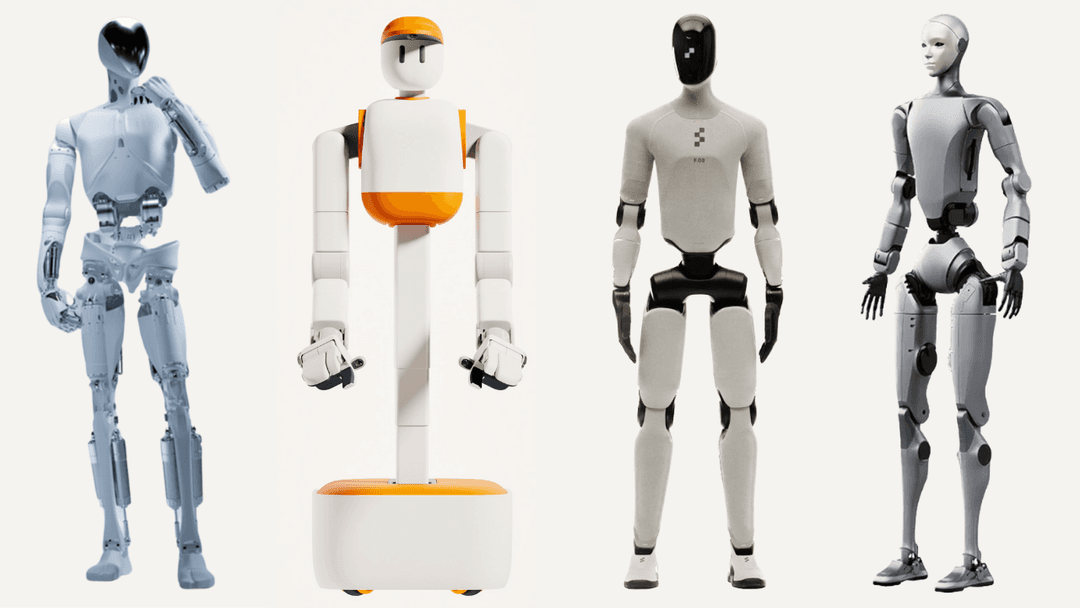
2025 wasn't the year humanoid robots showed up in your home. It was quieter than that. Fewer flashy promises, more real systems working in actual environments, and clearer signals about which companies understand what this problem actually requires.
Not every launch mattered equally. Here's the breakdown.
Tier 1: The launches that change how the industry moves
Figure 03 — Figure AI
Why it matters: Iteration speed
Figure AI — drawing on engineering talent from Tesla, Boston Dynamics, and OpenAI, keeps shipping new versions of their humanoid faster than anyone else in the space. Figure 03 isn't a dramatic leap. It learns faster, handles objects better, and moves more smoothly than its predecessor. The significance is the pace, not the product. By iterating constantly in the real world rather than waiting for a definitive version, Figure is compressing the timeline for the whole field and forcing competitors to either match the speed or fall behind.
Watch for: whether iteration speed converts into large-scale deployments, or stays impressive at the demo stage.
Kepler K2 "Bumblebee" — Kepler Robotics
Why it matters: It's actually being manufactured
Most humanoid companies are still in prototype mode. Kepler, a Chinese robotics company, started mass-producing K2 in 2025 and putting units to work in real factories. That's a different category of company. Treating a humanoid as an industrial product that needs to be manufacturable, cost-controlled, and reliable — rather than a research project — is a shift in thinking that most of the field hasn't made yet. If humanoids succeed at scale, it'll be because someone figured out the manufacturing side. Kepler is the furthest along on that.
Watch for: Whether K2 deployments expand beyond tightly controlled factory environments into more varied roles.
Memo — Sunday Robotics
Why it matters: training economics
Sunday Robotics isn't building the most capable humanoid. They're attacking a different problem: the cost of teaching robots new tasks. Most training approaches are either expensive (a human operator puppeteering the robot through every task) or risky (uncontrolled real-world trial and error). Memo uses a Skill Capture Glove — a person wears it while doing a household task, every hand movement is recorded, and Memo learns to replicate it. According to Sunday Robotics, this makes training cheap enough to run at scale in real homes rather than controlled labs. If that holds up, it changes the economics of the whole industry.
Watch for: Whether this training approach transfers to more physically capable robots, or stays specific to Memo's form factor.
Tier 2: Meaningful bets, unproven at scale
H2 — Unitree Robotics
Why it matters: Cost floor
Unitree, best known for making affordable robot dogs used widely in research, brought their humanoid H2 to wider availability in 2025. The hardware isn't the most capable in the field. The point is the price. When humanoid robots are cheaper to access, more labs and startups can experiment without needing large budgets. That indirectly accelerates the field — more teams running more experiments means more learning, faster.
Watch for: Whether low unit cost comes at the expense of the capability improvements needed to stay relevant.
Iron — Xpeng Robotics
Why it matters: Automotive manufacturing infrastructure
Xpeng is a Chinese EV manufacturer. In 2025 they unveiled Iron, a humanoid that's closer to human in appearance than most of its competitors — deliberately so. The anthropomorphism is partly design philosophy, partly marketing. What's more interesting is the production infrastructure behind it. Automotive manufacturing supply chains are built for scale, precision, and cost reduction in ways that purpose-built robotics factories aren't yet. If Xpeng applies that infrastructure to humanoid production, they could scale faster than companies building manufacturing capability from scratch.
Watch for: Whether Xpeng's automotive expertise produces volume-ready humanoids, or whether Iron stays a high-spec showpiece.
Tier 3: Early positions worth tracking
4NE-1 Gen 3 — Neura Robotics
Why it matters: Cognitive integration
Germany's Neura Robotics is taking a different angle: robots that understand their environment well enough to work safely alongside people, not just next to them. Most humanoids are built for structured, predictable tasks. The cognitive layer Neura is developing — spatial understanding, safe human interaction, situational awareness — is what humanoids will need to move into less controlled environments. The risk is pace: US and Chinese competitors are iterating faster, and being right about the hard problem doesn't help if you're two years behind.
Watch for: whether Neura can maintain a technical edge as faster-moving competitors catch up on the cognitive side.
A-Series, X-Series, G-Series — AgiBot
Why it matters: Execution discipline
AgiBot doesn't make dramatic announcements. Their humanoid lineup — the full-size A-Series, half-size X-Series, and task-specific G-Series — won't make a viral demo reel. What they do is take robots from prototype to working in factories, on schedule, reliably. In late 2025, AgiBot announced the rollout of their 5,000th humanoid. For context, most companies in this space are still counting deployments in the dozens. AgiBot is counting in thousands. Execution at that level is harder than it looks.
Watch for: Whether AgiBot can expand beyond narrowly defined tasks into more flexible roles.
What 2025 actually showed
The companies that moved furthest in 2025 weren't the ones with the most impressive robots on stage. They were the ones focused on manufacturing volume (Kepler), training cost (Sunday Robotics), and iteration speed (Figure). Those are operational problems, not research ones.
The robots that look most human — Iron, the Neura designs — are the most interesting to look at and the least proven in the field. That's not a coincidence. Anthropomorphism is easier to show than reliability.
The honest read on where things stand: AgiBot's 5,000 units and Kepler's volume production are the closest the industry has gotten to actual scale. Neither is at the level where "humanoid robots are everywhere" becomes a defensible claim. But 2025 was the year the conversation shifted from whether this is possible to who's going to get there first. That's a real change.