
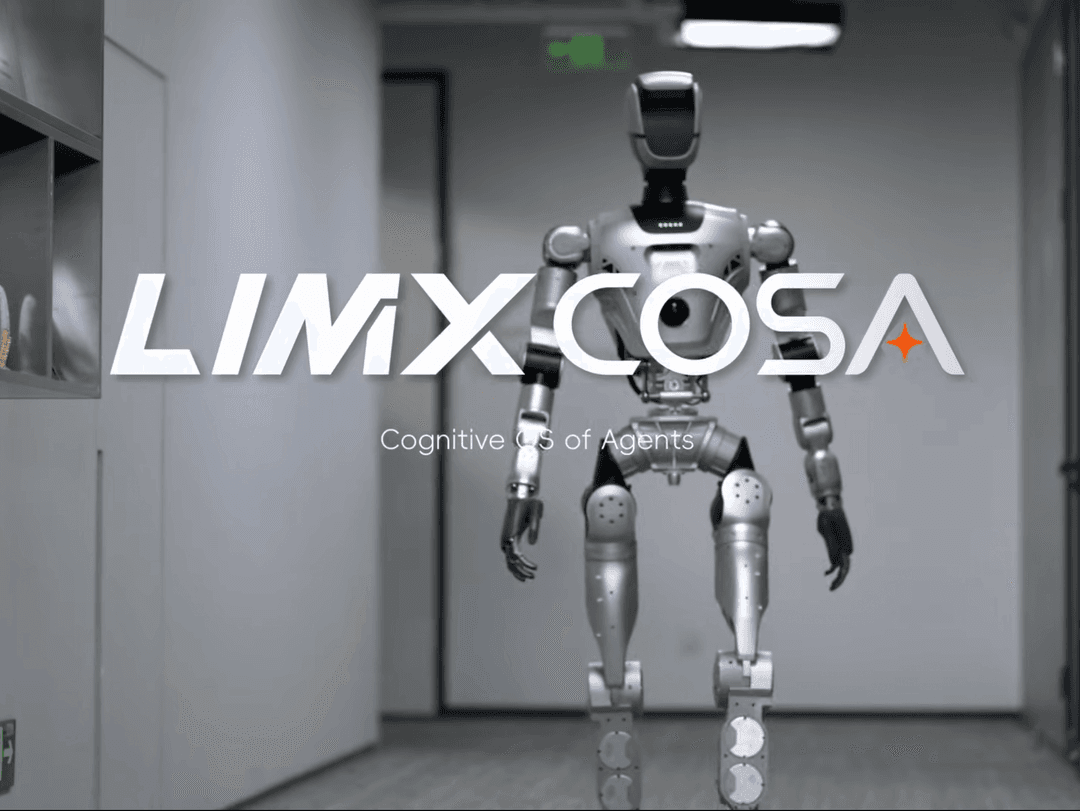
On January 12, 2026, Shenzhen-based robotics company LimX Dynamics launched COSA (Cognitive OS of Agents), which it describes as the first operating system designed from the ground up for humanoid robots operating in real-world environments. Its potential has been compared to Android’s role in smartphones: a shared software layer that could run across hardware from multiple manufacturers.
COSA introduces two notable capabilities. The first is Semantic Memory, which allows robots to retain information about their environment and use it later without explicit prompting. Instead of treating every interaction as new, the robot builds on past experience. The second is coordinated whole-body control, enabling simultaneous manipulation and locomotion. Rather than choosing between walking or working with its hands, the robot can do both at once.
LimX demonstrates these capabilities using its humanoid robot, Oli. Standing about 165 cm tall and weighing roughly 55 kg, Oli has been shown navigating complex environments while performing multi-step tasks. The system signals a shift away from tightly scripted robots toward systems that operate with a degree of situational understanding.
What Is COSA?
COSA is an operating system built specifically for humanoid robots expected to function outside controlled factory settings. The goal is to gain enough situational understanding to support robots working in environments that are cluttered, dynamic, and unpredictable.
The system is designed to tightly couple perception, planning, and motion. In many existing robot architectures, these components are loosely connected, resulting in stop-start behavior. COSA aims to eliminate that separation so perception, reasoning, and action unfold continuously.
The Android comparison is intentional. Android is not a phone, but a shared software foundation that supports many different devices. LimX is positioning COSA in a similar role: a common control and cognition layer that could run on humanoid robots from different manufacturers.
COSA is built around the idea of robots acting as agents rather than passive tools. An agent maintains internal state, remembers prior interactions, and adapts behavior over time. This contrasts with conventional robots that execute predefined routines with limited context awareness.
Three characteristics underpin this approach:
- Continuous integration of cognition and motion
- Persistent memory of environments and interactions
- Simultaneous manipulation and locomotion
How COSA Works
COSA’s architecture is inspired by the human nervous system. Traditional robots often exhibit brief pauses as control alternates between planning and execution. COSA is designed to avoid these interruptions.
The system is structured into three layers that operate concurrently.
The lowest layer handles balance and locomotion. It maintains stability across uneven terrain such as sand, rubble, stairs, or loose boards. This layer is responsible for preventing falls when the robot encounters irregular surfaces.
The middle layer manages task-level skills. These include actions such as stair climbing, obstacle avoidance, and object manipulation. It coordinates closely with the locomotion layer to ensure stability during task execution.
The top layer performs high-level reasoning. It interprets instructions, decomposes tasks, evaluates alternatives, and responds to unexpected changes. This layer governs decision-making rather than direct motor control.
The key point is that these layers do not operate in sequence. They run continuously and in parallel, allowing the robot to adjust its behavior without stopping.
What Makes COSA Different
Thinking While Moving
Most robots follow a stop–plan–move cycle because their cognitive and motor systems are loosely integrated. COSA breaks this pattern.
A COSA-powered robot can adjust its plan mid-motion. In demonstrations, Oli continues walking toward a destination while accepting and reordering new tasks. The robot reprioritizes internally rather than pausing to recompute from scratch.
Persistent Memory
Many robots treat perception as transient. They map their surroundings but do not retain meaningful context across interactions.
COSA introduces persistent semantic memory. The robot maintains knowledge of locations, objects, and people, and can reference that knowledge later. In demonstrations, Oli independently noted that a printer was out of paper, without being instructed to inspect it.
This capability changes how robots behave. Instead of waiting for commands, the system can identify issues and surface them proactively.
Coordinated Hands and Feet
COSA supports simultaneous manipulation and locomotion. Most humanoid systems handle these tasks separately.
Oli has been shown carrying objects while navigating uneven staircases. Maintaining balance while performing dexterous manipulation is a nontrivial control problem, and this capability significantly expands the environments in which a robot can be useful.
Oli: The Demonstration Platform
Oli is LimX’s humanoid robot and the primary platform used to showcase COSA. It was first presented publicly at the World Robot Conference in Beijing in July 2025.
Oli stands approximately 165 cm tall, weighs around 55 kg, and features 31 degrees of freedom. LimX offers multiple configurations depending on use case, with pricing starting at approximately $21,800.
LimX also provides a software development kit, allowing COSA to be adapted to other humanoid hardware. The company has stated that COSA is intended to support robots beyond its own platforms.
Demonstrated Capabilities
Most available evidence comes from LimX-produced videos and public demonstrations.
- Uneven terrain locomotion: walking across sand, rocks, debris, and boards
- Stair climbing: including extended staircases such as those at Guangzhou’s Canton Tower
- Concurrent task execution: reprioritizing tasks mid-motion
- Object handling: carrying items while moving and recovering from falls
Additional demonstrations include synchronized movement with other robots and gym-style exercises. These are primarily illustrative of control flexibility rather than functional deployment.
Reality Check
There is limited public data on long-term, real-world deployments. Most demonstrations are controlled and curated.
Some observers have questioned the authenticity or representativeness of certain videos, while others point out that robotics marketing often emphasizes best-case performance. These concerns are reasonable.
The underlying design goals—continuous cognition, persistent memory, and whole-body coordination—are technically sound. The open question is how reliably these capabilities perform outside demonstrations and whether COSA can scale across platforms and use cases.
Broader Context
LimX has released several other robotic platforms, including the modular TRON 2 robot and the DreamActor training framework, which combines real-world, simulated, and video-based data.
Across the industry, humanoid robotics in 2026 is trending toward general-purpose systems with stronger AI integration. Other companies, including Boston Dynamics in collaboration with Google DeepMind, are pursuing similar goals.
Bottom Line
COSA reflects a broader shift in humanoid robotics away from tightly scripted behavior toward systems that integrate perception, memory, reasoning, and motion.
Whether COSA becomes a widely adopted platform depends on its performance outside demonstrations and on whether other manufacturers choose adoption over in-house development.
If the system performs as advertised, it addresses long-standing limitations in humanoid robotics. If not, it still represents a clear signal of where the field is heading.