
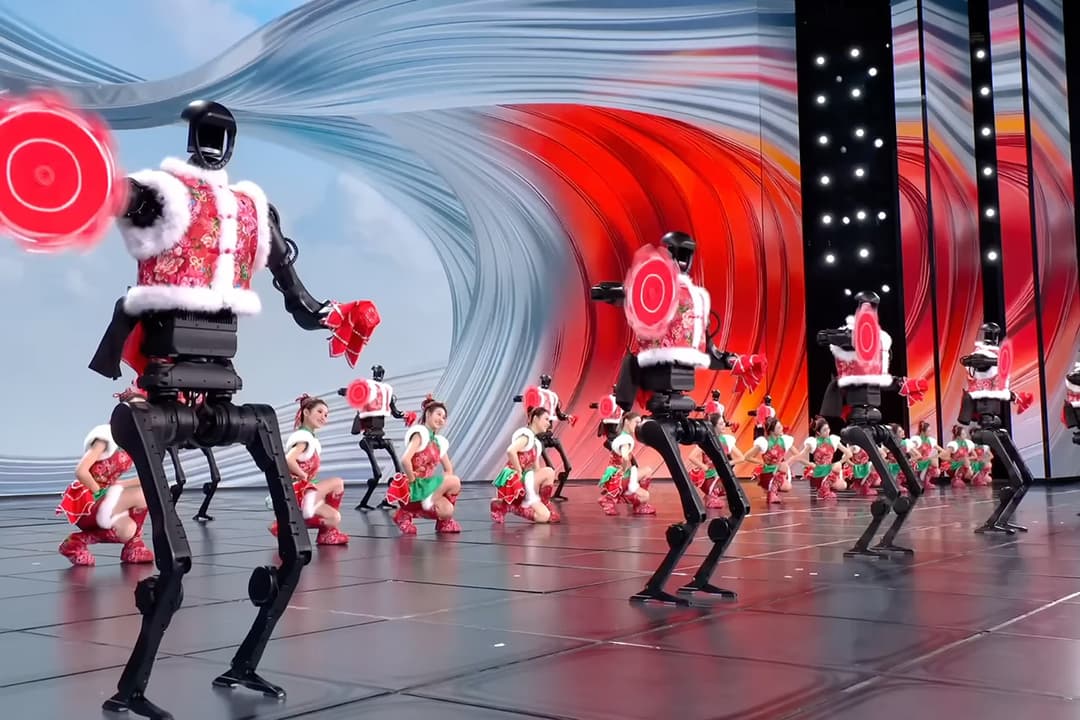
If you have been even remotely following humanoid news, chances are you have seen at least one humanoid dance demonstration — maybe it was this one, or this one, or this one, or more recently this one. At this point it seems like dancing is a rite of passage for humanoids to be taken seriously.
This leads to the question — why do robot companies make their humanoids dance?
It’s simply because dance routines are one of the best stress tests for a humanoid’s whole system. At the same time, dancing is also one of the most effective marketing tools.
Integrated Systems Test
Dancing synchronizes balance, motion planning, perception, and actuation at once.
Unlike simple walking, a choreographed routine forces the robot to shift weight dynamically, coordinate upper and lower limbs in non-repetitive patterns, and recover balance mid-motion.
Controlled Yet Complex Environment
Dance routines happen on a flat, predictable floor with known lighting and timing — ideal for demonstrations without risking damage.
It’s a sweet spot between lab safety and dynamic performance.
If a robot can dance smoothly, it’s a strong sign that its control stack is well-integrated.
Benchmark for Dynamic Control
Dance movements are a proxy for agility and real-time adaptability — the same traits needed for future use cases like industrial manipulation, search & rescue, or logistics.
It’s safer to show off those dynamics in a dance than in a warehouse while being entertaining.
Human Relatability
Humanoids are designed to operate in human-centered environments, and dance is a universal human behavior.
A dancing robot triggers emotional and social reactions that demonstrate “human-like” fluidity, build public familiarity, and attract viral attention.
Boston Dynamics’ viral “Do You Love Me?” video in 2020 is a textbook example — it shifted public perception from “scary robot dog” to “technical marvel.”
Showmanship & Investor Appeal
A dance video tells a visual story that’s instantly understandable, even to non-engineers.
That’s powerful for media outlets and investors who want to see embodied AI progress at a glance.
TL;DR
Humanoid robots dance because it’s the perfect blend of:
- Technical integration test
- Emotional engagement
- Marketing visibility
It’s less about art, and more about proving that the robot’s hardware, software, and coordination can handle real-world complexity — while making people smile.
Case Studies
Boston Dynamics
Boston Dynamics released a widely viewed video in 2020 featuring Atlas, Spot, and Handle performing to “Do You Love Me?” by The Contours.
Later, Spot robots danced on America’s Got Talent and collaborated with BTS and Hyundai in a branded video.
My take:
The demos emphasize agility, coordination, and balance — designed for viral appeal.
Founder Marc Raibert noted that the routine forced upgrades in motion control tools.
The focus is motion performance, not utility — polished spectacle that showcases engineering prowess.
Unitree Robotics
In 2025, Unitree showcased 16 H1 humanoid robots performing a synchronized folk dance (“Yangge”) during China’s Spring Festival Gala.
They also posted a video of their G1 robot dancing around a soccer ball while enduring a “stick attack.”
My take:
The large-scale stage performance highlights mass synchronization and show production value.
It signals technological capability and stability, while the “stick attack” demonstrates robustness under perturbation.
This strategy focuses on resilience and reliability under pressure.
Tesla
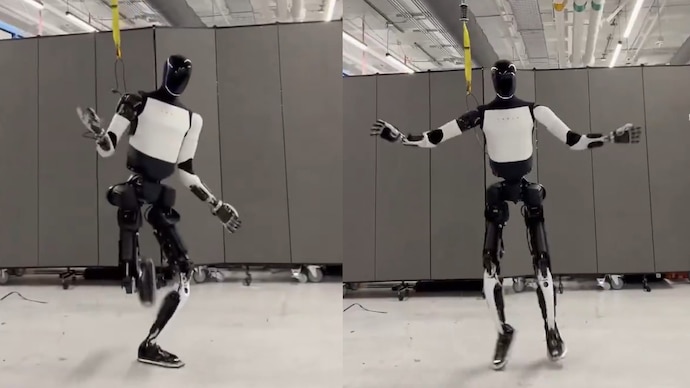
Optimus humanoid robot (Image credit: Tesla)
In May 2025, Tesla shared a clip of Optimus performing coordinated movement routines — pirouettes, hopping, and footwork — claiming “no CGI” and “real-time speed.”
Engineers said the motion was trained entirely in simulation and zero-shot transferred to the real robot.
My take:
Tesla is highlighting embodied intelligence and simulation-based learning pipelines.
The message is that Optimus’ motion control is scalable via software and data — just like Tesla’s approach to autonomous driving.
However, given Tesla’s history, the demo may serve more as strategic signaling than proof of readiness.
Closing Thoughts
So yes, humanoids dance because it’s the hardest easy thing.
It’s technical validation, marketing theatre, and strategic signaling rolled into one routine.
For all the flash, dancing demos serve a deeper engineering philosophy:
If you can dance, you can do anything.
The precision, balance, and coordination required to move rhythmically to music directly translate to industrial, household, and assistive tasks.
Tesla, Boston Dynamics, and Agility all claim that progress in dance transfers to practical motion control — dance today, deliver boxes tomorrow.